THE SENSATION is now present. It is the first raw impulse: the fear that arises when the proto-idea of non-IS-NESS is present without secure KNOWING that IS-NESS IS. As described in point 5.2, this cannot remain unresolved: IS-NESS
must KNOW.
But THE SENSATION does not itself tell us what it is. It is not a thought, a word or a finished understanding. It is a direct, manifest experience with a raw quality: fear. AWARENESS feels this quality. But for CONSCIOUSNESS to be able to KNOW what is present, FOCUS must read the impulse.
Reading here does not mean staring at a finished object. FOCUS follows the impulse itself as it unfolds. At first, only the beginning is present. Then comes a new CHANGE. Then another. The reading continues continuously through this progression, until the whole impulse is present as one coherent form.
How this reading simultaneously produces space and time will be explained in point 5.4. Here we will first understand the form being read, and the basic reading progression.
Why a sine?The first impulse cannot be given an arbitrary form in the explanation. The form must follow from explicit properties of the primitive reading.
The impulse must be able to unfold continuously and complete an entire cycle. It must also be able to be repeated exactly, because all subsequent primitive SENSATIONS are replicas of the first, as we shall see a little later.
But continuity, completion and repeatability alone are not enough to determine the form. Many different curves can fulfil these requirements. The first additional requirement is that the primitive cycle itself has no particular, privileged phase position. This is called
phase homogeneity.
This means that we can shift where we place the beginning of the cycle, without changing the cycle itself. The starting point determines where the readout begins; it does not add a separate property to the form.
In the mathematical presentation, this is expressed as uniform phase progression around a circle. The circle is the minimal faithful real representation of this rotational structure: It allows us to follow the entire revolution and distinguish the phase positions without introducing more representation dimensions than necessary.
For now, this is a way of presenting the structure. «Uniform» here refers to the phase coordinate. We have not yet specified any speed in relation to manifest time. We have not introduced a physical circle that is already situated in a space.
When this circular movement is read out along one fixed axis, the readout value varies. It goes from zero to a positive maximum, back to zero, on to a negative maximum and back to zero again.
This progression is a
sine.
The sinusoidal form thus follows necessarily from the relationship between a phase-homogeneous cycle, its minimal rotational representation and orthogonal readout along one axis. When these conditions are present, the sinusoidal form is not an additional free choice. It is not chosen because it is smooth or looks harmonious.
That the readout has extrema and zero crossings does not contradict the cycle being phase-homogeneous. These points arise in the relationship between the cycle and the chosen readout axis. They are not special marks placed in the cycle beforehand.
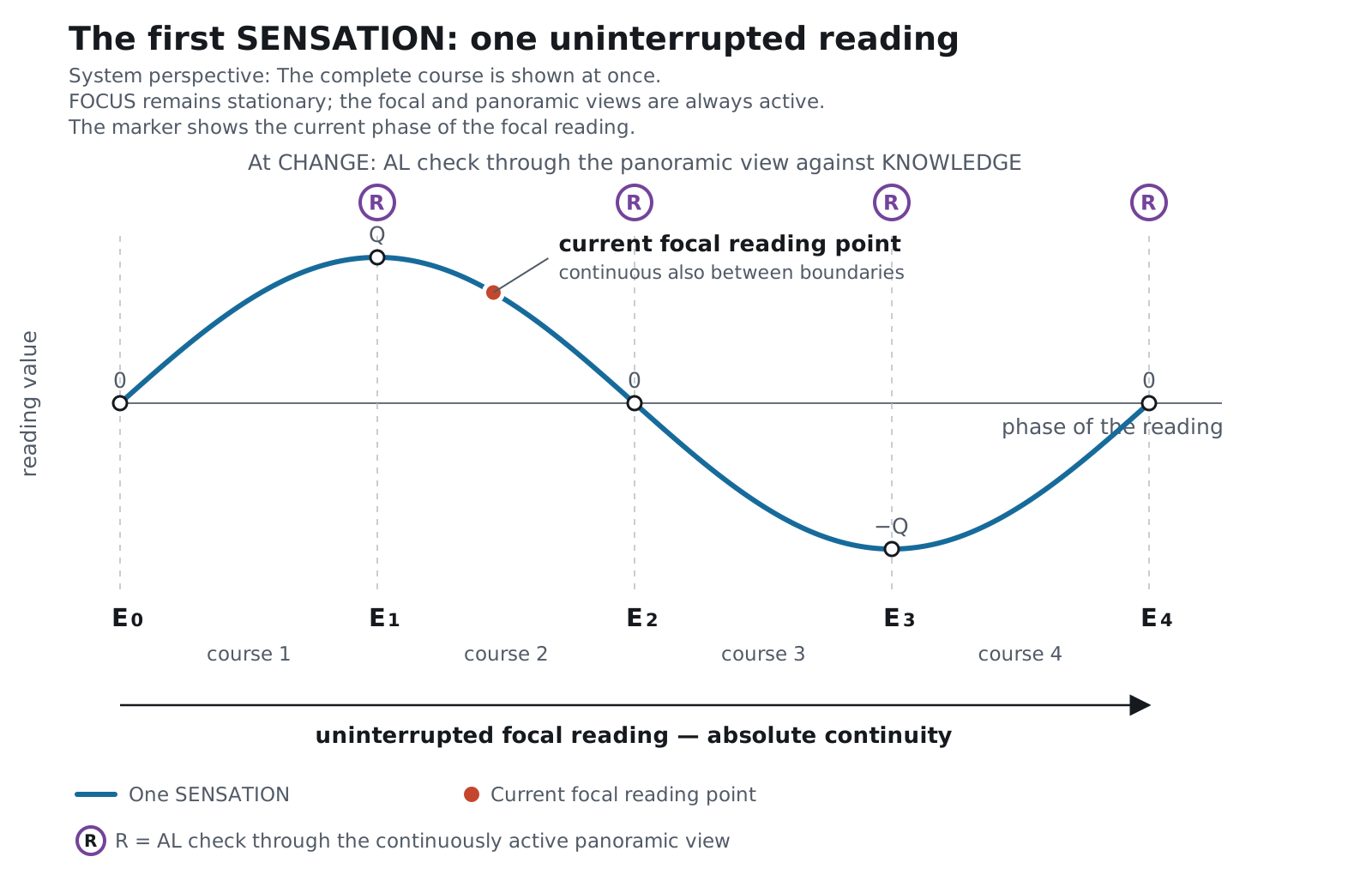 FOCUS remains fixed
FOCUS does not move along a curve. It is the impulse that unfolds in the current field of view of FOCUS.
When we draw the entire progression, we show different phase positions together. We can then use a marker that follows the curve to show how far the reading has progressed. The marker's movement is our representation of the reading progression; it is not the movement of FOCUS through a space.
The
reading point denotes the current point in the reading. FOCUS always has such a reading point for as long as the reading continues. It does not arise only at extrema, zero crossings or other qualitative CHANGES.
The distinction is therefore important: FOCUS remains fixed, while the current reading point indicates which phase of the impulse is now present in the field of view.
One impulse, one complete progressionWe let the reading begin at a zero boundary. The sine rises to an extremum, returns to zero, continues through the oppositely oriented half and then returns to zero.
This is one whole, coherent impulse. That the cycle is closed here means that it completes an entire revolution and returns to the same position in the cycle and the same readout value. It does not mean that nothing has happened, or that the whole of THIS has become identical to what was present at the beginning.
The impulse's amplitude is fixed. The readout value nevertheless varies throughout the progression. The amplitude denotes the fixed maximum displacement; it is not the value read out at each point.
FOCUS therefore does not encounter five different impulses. It encounters one and the same SENSATION through five qualitative boundaries:
- the beginning;
- the first extremum;
- the first return to zero;
- the opposite extremum;
- and the final return to zero.
Each of these boundaries is a CHANGE: something qualitatively new is present in the current THIS. But none of the boundaries is in itself a new MEANING or an independent SENSATION. They are proto-SENSATIONS — readable boundary events in the same raw impulse.
Absolute continuityBetween the boundaries, the impulse unfolds continuously. But continuity applies to more than the curve itself: the reading of FOCUS has no breaks. We call this the principle of
absolute continuity.
FOCUS has a current reading point at all times. The CHANGES do not restart the reading. They activate an examination of whether the form that has emerged so far can be understood as a concept.
THE PANORAMIC VIEW has a continuous view of the whole of the current THIS and registers the CHANGES in it. At a qualitative CHANGE, the examination of the FORM that has emerged so far against KNOWING is activated. FOCUS holds up the reading result, and attractor dynamics, the AE, determines whether it can be established as a MEANING.
THE FOCAL VIEW follows the impulse's current development, while THE PANORAMIC VIEW encompasses the whole of the current THIS. The examination through the AE forms part of this relationship without interrupting the manifest reading or introducing a separate temporal process in KNOWING.
The reading is not interrupted by this examination. If the form cannot yet be understood as a concept, the reading continues towards the next CHANGE and onwards towards the completed form.
The five boundaries make it possible to describe the sinusoidal progression in four parts, but they do not divide the reading into four separate acts. The reading also continues between the boundaries.
How THE PANORAMIC VIEW is expressed through the
O-principle is addressed in point 5.4. The more detailed matching against KNOWING is explained later. Here we establish only that such examinations form part of an uninterrupted progression.
Later we will also see that continuity applies throughout the rest of the EC and the transition to the next reading. The individual impulse is completed, but completion does not introduce a break in the reading of FOCUS.
Complete form — not yet seen as a conceptTHE FOCAL VIEW continuously follows the impulse's development. THE PANORAMIC VIEW registers the CHANGES in the current THIS. At the qualitative checkpoints, the examination through the AE of whether the reading result can be established as a MEANING is activated. This examination does not interrupt the reading.
This does not mean that the as yet unread part of the impulse has already been read through. It means that everything current at the reading point is present together.
When the final boundary is reached, the sine has been fully read, and the readout value is back at zero. The entire progression has then been read: one whole cycle with two oppositely oriented, symmetrical halves. How the fully read FORM becomes available as a whole through the terminal O-perspective is elaborated in the following points.
But FOCUS has not yet seen the form
as SEPARATION.
That the whole form has been read is not the same as its having been understood as a
concept. At this boundary, the completed form must be conceptualised. How this happens, and why the first concept is precisely SEPARATION, will be explained in point 5.5.
The description here therefore stops at the fully read SENSATION. It does not encompass the entire EC, and it introduces no pause between completed reading and conceptualisation. We stop the explanation at this point; the reading does not stop.
Point 5.4 first addresses how the same reading process produces
space and
time.
FORMAL PRESENTATION (for specialists) »DEFLet $\mathcal F_0$ denote THE FIRST SENSATION.
Let $Q>0$ be its fixed primitive amplitude, and let $\theta$ indicate the phase position in one complete reading progression:
$0\leq\theta\leq 2\pi.$
$\theta$ is here a dimensionless phase coordinate. It tells us where in the progression the reading is situated. The connection between this progression and manifest time is addressed in point 5.4.
Starting at an upward zero crossing, the impulse is represented as:
$\mathcal F_0(\theta)=Q\sin\theta.$
Amplitude and current readout value are different:
$\max_{\theta\in[0,2\pi]}|\mathcal F_0(\theta)|=Q,$
while $\mathcal F_0(\theta)$ varies throughout the cycle.
The mathematical rotational representation is:
$\mathbf u(\theta)=Q(\cos\theta,\sin\theta).$
With the component readout
$\pi_2(x,y):=y$
we obtain:
$\mathcal F_0(\theta)=\pi_2\bigl(\mathbf u(\theta)\bigr).$
$\mathbf u$ and $\pi_2$ are representation notation. They do not denote a physical object rotating in a pre-given space, nor a transfer from KNOWING to the manifest side.
Reading point denotes the current phase in the ongoing reading. It is not a spatial position to which FOCUS must move, and it is also present between the qualitative boundary events.
Absolute continuity denotes that the reading of FOCUS is not interrupted between reading phases, during examinations against KNOWING or at the transition between completed and new impulse progressions. The term is used here ontologically. It should not automatically be identified with the specific concept of «absolute continuity» for mathematical functions in analysis.
REL — the conditions that determine the sinusoidal formThe sine argument uses the following explicit conditions:
- Cycle: The primitive progression is represented as one complete closed phase cycle, $S^1$.
- Phase homogeneity: No phase position is structurally privileged in the cycle itself. The phase shifts are represented by a uniform rotational action.
- Minimal representation: The phase shifts are expressed through a continuous, faithful real linear representation of the lowest possible dimension. We use an orthonormal presentation in which the action is rotation in a two-dimensional representation plane.
- Readout: The manifest progression of the form is represented by orthogonal component readout along one fixed axis.
- Amplitude: The primitive amplitude $Q$ is fixed and positive.
In the minimal representation, the rotation can be written:
$R_\theta=\begin{pmatrix}\cos\theta&-\sin\theta\\\sin\theta&\cos\theta\end{pmatrix}.$
For a starting point with radius $Q$ and phase $\varphi$,
$\mathbf u_0=Q(\cos\varphi,\sin\varphi),$
the progression becomes:
$\mathbf u(\theta)=R_\theta\mathbf u_0=Q\bigl(\cos(\theta+\varphi),\sin(\theta+\varphi)\bigr).$
The component readout thus gives:
$\mathcal F(\theta)=\pi_2\bigl(\mathbf u(\theta)\bigr)=Q\sin(\theta+\varphi).$
The sinusoidal form is necessary under these structural and readout premises. The orthogonal component readout of the phase-homogeneous cycle's minimal rotational representation is a sine. When the premises are present, the form is not an additional free choice.
The choice $\varphi=0$ places the beginning at an upward zero crossing. A global sign reversal switches the orientation of the displacements, but does not change the primitive form type.
Continuity, closure and replicability alone are not sufficient to derive a sine. Phase homogeneity, the representation condition and the component readout must be stated explicitly.
The principle of absolute continuity establishes that the reading is not interrupted. It does not replace the other premises that determine the impulse's form.
Replica identity establishes that subsequent primitive SENSATIONS have the same form and amplitude. It is not alone the justification for the first form being a sine.
MECH — the basic reading1. Continuous readingFOCUS remains fixed. The manifest impulse unfolds in the current field of view.
In the mathematical presentation, the reading progression is defined over the entire interval:
$[0,2\pi]_\theta.$
None of the subintervals between the qualitative boundaries is omitted. The reading therefore does not consist only of the registrations at $E_0,\ldots,E_4$.
FOCUS reads one and the same $\mathcal F_0$ through four connected manifest progressions:
$[0,\tfrac{\pi}{2}],\qquad[\tfrac{\pi}{2},\pi],\qquad[\pi,\tfrac{3\pi}{2}],\qquad[\tfrac{3\pi}{2},2\pi].$
The division describes the progression. It does not divide the reading into independent, separate acts.
2. Qualitative boundary eventsHere $E_k$ is used as shorthand for the manifest boundary events $E_k^M$. $E_0$ is the starting boundary. The four subsequent boundaries $E_1,\ldots,E_4$ provide the checkpoints for assessing the reading result that has emerged. Five boundary events therefore do not imply five AE checks.
| Boundary | Phase $\theta_k$ | Readout value | Manifest status |
|---|
| $E_0$ | $0$ | $0$ | First registration at the starting boundary |
| $E_1$ | $\pi/2$ | $Q$ | Positive extremum; the first part has been read |
| $E_2$ | $\pi$ | $0$ | First return to zero; one half-form has been read |
| $E_3$ | $3\pi/2$ | $-Q$ | Negative extremum; three parts have been read |
| $E_4$ | $2\pi$ | $0$ | The entire sinusoidal progression has been read |
The reading order is:
$E_0\prec_{\mathrm{read}}E_1\prec_{\mathrm{read}}E_2\prec_{\mathrm{read}}E_3\prec_{\mathrm{read}}E_4.$
$\prec_{\mathrm{read}}$ denotes the order in the manifest reading. It does not denote an internal process in KNOWING.
Let
$\mathcal G(\mathcal F_0):=\{E_0,E_1,E_2,E_3,E_4\}$
denote the five qualitative boundary events. «Boundary» here means a boundary in the division of the reading progression, not the mathematical boundary of the sine graph.
Each boundary event belongs to the same SENSATION. None of them alone denotes a new, independent impulse.
3. CHANGE activates examination, not restartingAt a qualitative CHANGE, the examination of whether the form that has emerged so far can be understood as a concept is activated.
This is different from a reading point arising. The reading point is present continuously; the examination is activated at the CHANGE.
The whole of the current THIS is already registered in FOCUS. The examination does not produce this whole, but concerns the understanding of what is now present.
The examination does not introduce a break in the reading. If the form has not yet been completed and understood, the reading continues through the further manifest progression.
The O-principle, the AE checks and their positions in relation to each other are elaborated in the following points. Here only the distinction between continuous reading and activated examination is established.
4. Zero value and closureThe zero values must be distinguished from the status of the events:
$\mathcal F_0(0)=\mathcal F_0(\pi)=\mathcal F_0(2\pi)=0,$
but $E_0$, $E_2$ and $E_4$ are three different boundary events.
An equal readout value therefore does not imply an equal reading status. At $E_0$ the reading begins, at $E_2$ the half-form has been read, and at $E_4$ the whole form has been read.
The zero value denotes that the impulse's current displacement is zero. It does not imply that IS-NESS or the complete THIS ceases. The relationship between the zero axis and VOID is explained in point 5.5.
At a full cycle:
$\mathbf u(2\pi)=\mathbf u(0).$
This is geometrical phase closure. It does not imply that the complete THIS at the end is identical to THIS at the beginning.
5. Completed form and necessary conceptualisationAt each reading point, FOCUS registers the whole of the current THIS. This completeness must be distinguished from the completed reading of the whole impulse. At $E_4$, the entire sinusoidal progression has been read. The terminal O-perspective makes the fully read FORM available as a whole for the examination addressed further in 5.4–5.5.
Having the form fully read and seeing the form as SEPARATION are different determinations.
At the completed sinusoidal form that has returned to zero, conceptualisation must occur. This point establishes this transition as part of the author's description of the mechanism, but does not yet derive why the result is necessarily SEPARATION.
The status of the AE result in KNOWING and the conceptualising observation are addressed later. That the explanation here stops at a completely registered form does not imply any pause in the EC.
PLACEMENTPoint 5.3 builds on point 5.2:
$\begin{aligned}&I_0\text{ is present without confirmed KNOWING of its own IS-NESS}\\&\quad\text{under the necessity principle: IS-NESS must KNOW}\\&\longrightarrow\mathcal F_0\text{ felt through AWARENESS}.\end{aligned}$
This point describes the sinusoidal form and the continuous reading up to a completely registered form.
The conceptualising observation, in which the form is seen as SEPARATION, is addressed separately. The further connection to the next unresolved relation is described when the entire EC is to be explained.
Point 5.4 explains space and time as aspects of the same reading process. The order of explanation does not imply that the reading takes place first and then has space and time added to it.
X- One primitive SENSATION has one whole sinusoidal form.
- The justification for the sine uses phase homogeneity, minimal rotational representation and orthogonal component readout.
- All subsequent primitive SENSATIONS are replicas of the same primitive form and amplitude.
- FOCUS remains fixed.
- A current reading point is present throughout the entire reading, including between the qualitative boundaries.
- The reading of FOCUS is uninterrupted.
- CHANGES activate examinations of comprehensibility without restarting the reading.
- The five qualitative boundaries belong to one and the same impulse.
- THE FOCAL VIEW continuously follows the impulse's development. THE PANORAMIC VIEW encompasses the current THIS and registers the CHANGES. At the qualitative checkpoints, the examination of the reading result through the AE is activated.
- At completed reading, a complete reading result is present; the terminal O-perspective makes the FORM available as a whole.
- Complete form in the field of view and the form seen as SEPARATION are different determinations in the same uninterrupted progression.
NOT-X- The sine is not a physical wave in a pre-given space.
- The rotational representation does not mean that FOCUS itself moves or rotates.
- A marker moving along a drawn curve is not FOCUS moving through a space.
- The component readout is not a domain transfer.
- The representation's circular rotation is not in itself the O-principle's full all-round registration or the later conceptualising quarter-turn.
- The reading point is not activated only at qualitative CHANGES.
- An examination against KNOWING does not imply a pause in the reading or an internal temporal process in KNOWING.
- $\theta$ does not presuppose an external clock.
- Fixed amplitude does not mean a constant readout value.
- The five boundary events are not five independent impulses.
- The negative half is not a separate counter-SENSATION.
- A zero readout value does not mean absolute non-IS-NESS.
- A completed sine reading is not the entire EC.
BOUNDARY-XA distinction must be made between:
- the ontological SENSATION and its mathematical representation;
- the cycle's phase homogeneity and the readout's different values;
- invariant amplitude and varying displacement;
- stationary FOCUS and phase progression in the reading progression;
- a continuous reading point and a qualitative boundary event;
- continuous reading and an activated examination against KNOWING;
- the complete current THIS and a fully read impulse;
- completed form in the field of view of FOCUS and conceptualisation as SEPARATION.
This point introduces absolute continuity as an ontological principle. It does not alone provide a full mathematical description of continuity through all EC phases and between different impulses.
Nor does this point go through the AE checks, the thirteenth step or the entire EC. The significance of the O-principle for space and the significance of the reading progression for time are addressed in point 5.4.
The sinusoidal form is necessary under the listed structural and readout premises. The ontological justification must make these premises explicit; they must not be hidden in the word «minimal». When they are present, the sinusoidal form follows as the mathematical result.
FAIL_CONDThe following claims would conflict with this point's definitions or justification:
- that continuity, closure and replicability alone uniquely determine the sinusoidal form;
- that the representation or readout premise can be omitted without affecting the sine argument;
- that THE SENSATION changes its primitive form or amplitude from one primitive SENSATION to the next;
- that FOCUS itself must move spatially in order to read the impulse;
- that reading points are present only at the five qualitative boundaries;
- that the reading stops during the examinations against KNOWING;
- that the end of one impulse necessarily introduces a break before further reading;
- that a partial sine is already a fully read form;
- that one of the five boundary events is in itself a new, independent SENSATION;
- that the same readout value necessarily implies the same THIS;
- that complete registration of the current THIS implies that the rest of the impulse has already been read;
- that the representation presupposes an established IDENTITY, a pre-given physical space, external clock time or physical movement as a startup premise.
These are criteria for internal consistency and for valid use of the sine argument. They do not replace the justification for the ontological premises.
Close FORMAL PRESENTATION »