In the previous point, FOCUS followed THE FIRST SENSATION through the entire sinusoidal progression. We described this as if a reading point were moving along the curve.
But FOCUS does not move.
FOCUS remains fixed in THE HORIZON. This does not mean that FOCUS is situated at a spatial point, because THE HORIZON is not a place. It means that FOCUS has an unchanging functional position between the two sides of the domains and can direct its view towards both.
On the manifest side, FOCUS follows and reads the impulses that arise. On the abstract side, FOCUS can register the content and the relations present in KNOWING. When established CONCEPTS later exist, fully read manifest forms can be recognised against them. During the first reading, no such conceptualised form yet exists. The only abstract content is the proto-idea that non-IS-NESS may be real.
FOCUS is therefore the HORIZON point that SEES both sides of the domains and makes it possible to
know about them.
But FOCUS cannot
feel the impulses. That ability belongs to AWARENESS. AWARENESS feels the impulse's raw quality and thereby gives rise to qualia, while FOCUS sees, reads and examines what is felt.
FOCUS therefore does not move through a manifest space or pass through a time that is already present. What changes is which value in the impulse's manifest development THE FOCAL VIEW reads at any given moment.
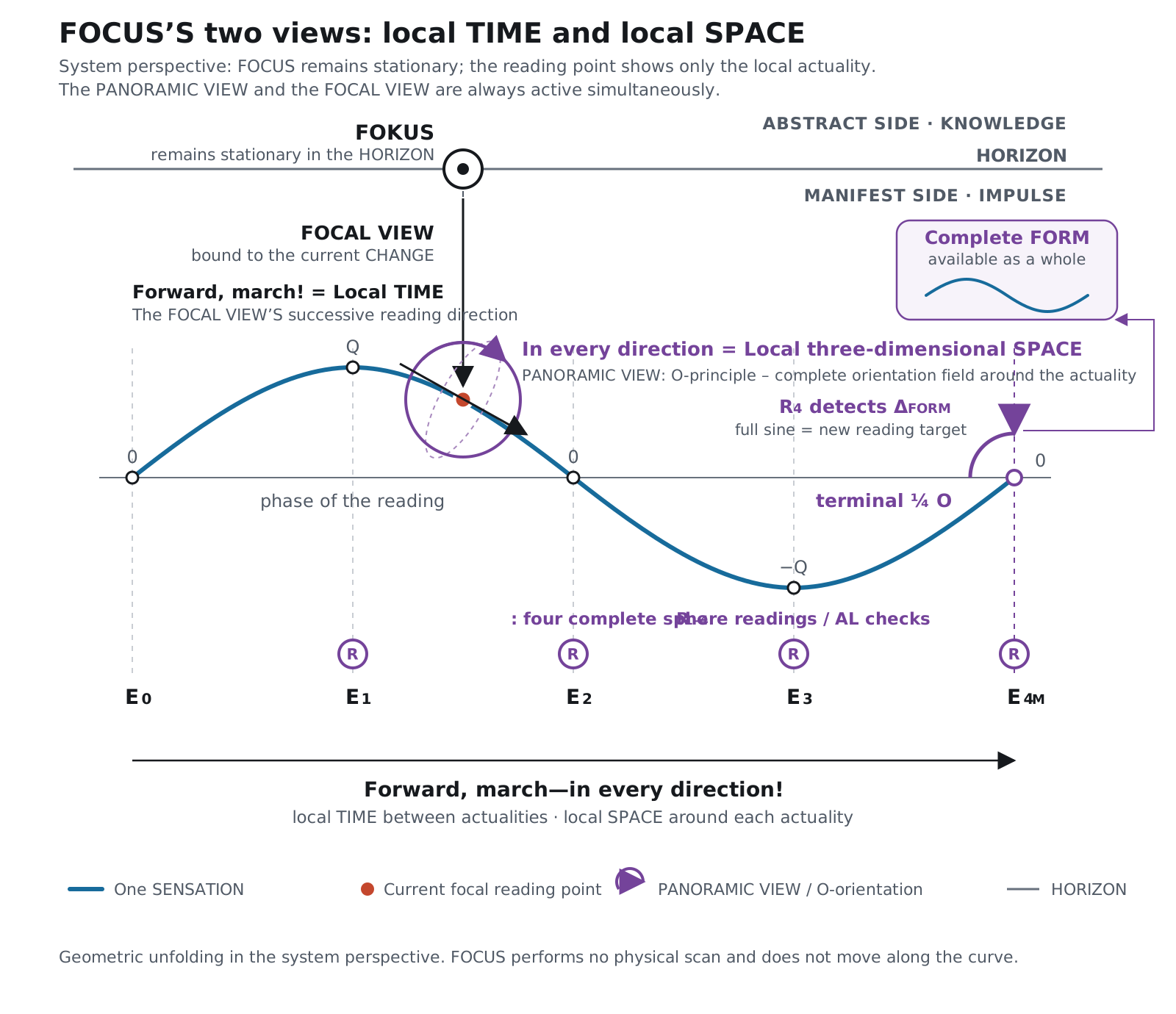
In the graphical presentation, this can be shown as a reading point moving along the sine curve. But the reading point is not FOCUS itself. It indicates only how far THE FOCAL VIEW has progressed in reading the impulse's manifest progression. FOCUS still remains fixed in THE HORIZON and simultaneously has an PANORAMIC VIEW towards the whole of the current THIS on both sides of the domains.
To understand how the reading can take place, we must now specify that FOCUS always has two simultaneous views:
- THE PANORAMIC VIEW, which registers the whole of the current THIS and detects CHANGES within it;
- THE FOCAL VIEW, which is bound to the nearest current CHANGE and reads it.
These are not two eyes, two actors or two acts that alternate in being active. They are simultaneous and inseparable properties of the one FOCUS. We humans can recognise this in our own vision. It is both broad and focused – at the same time. The eye and vision are, of course, something that arises much later, but the functional analogy is striking.
THE PANORAMIC VIEW is always active. It registers the whole of the current THIS and detects that a CHANGE is present. As the CHANGE is registered, THE FOCAL VIEW is bound to it and follows it through the manifest progression. This is a functional order – registration, binding and reading – not an alternation in which one view is switched off before the other is activated.
Nor is THE FOCAL VIEW switched off and on. It is always bound to something current. What changes is what is nearest at any given moment and therefore must be read.
FOCUS does not make a free choice between several possible reading targets. THE FOCAL VIEW cannot choose to overlook the nearest current difference and direct itself towards something else. It is necessarily drawn towards the nearest CHANGE in relation to what is already being read.
As a teaching device – so that you will remember and understand – I will venture to compare this to a «sexual gaze» that cannot resist
the irresistible attraction towards the nearest CHANGE. The comparison is not about sexuality as an ontological principle. It is only intended to make the immediate and involuntary attraction understandable: The gaze is captured before it has time to choose.
I call this
THE CHANGE GAZE.
THE CHANGE GAZE is not a third view alongside THE PANORAMIC VIEW and THE FOCAL VIEW. The term describes the interaction between them:
- THE PANORAMIC VIEW registers that a CHANGE is present.
- The nearest CHANGE receives priority.
- THE FOCAL VIEW is bound to the CHANGE and reads it.
By "nearest" we do not mean physical distance in an already existing space. Physical space is precisely what is to be produced. Nearness here means geometrical and relational nearness to what THE FOCAL VIEW is already bound to.
The prioritisation applies from the current local perspective. The same FOCUS simultaneously has a view through every perspective; this introduces no global queue of EC readings. Where nearness is equal, attractor support determines which CHANGE is activated, as specified in point 5.6.
During the first sine reading, there is only one manifest impulse. THE PANORAMIC VIEW therefore registers THE SENSATION and the CHANGES in its progression. THE FOCAL VIEW is bound to THE SENSATION and follows it without interruption from beginning to closure.
THE PANORAMIC VIEW does not disappear while this happens. It surrounds the current reading point throughout the entire progression. As long as the sinusoidal form has not been fully read and no nearer CHANGE has arisen, there is also nothing else to which THE FOCAL VIEW can be bound.
Time arisesThe reading begins at one actuality and continues to the next. What was just current is no longer current when the next CHANGE is present.
Here the first manifest time arises.
Time is not a container within which the reading takes place. There is no clock outside CONSCIOUSNESS that is already ticking. FOCUS therefore does not pass through a locally manifested time that exists independently of the reading process.
The reading-through by FOCUS
is the process that produces local time.
Time arises because FOCUS cannot read the entire sinusoidal progression as one undifferentiated point. The form must appear successively:
- this is present;
- then this;
- then this.
The first cannot come after the second without the reading direction being reversed. And even when the sine's readout value becomes negative, the reading continues forwards. A negative readout value does not mean negative time.
The parameter $\theta$, which we introduced in point 5.3, represents the order in the manifest reading and thus the primitive order of local time. It does not yet measure seconds. It is a dimensionless phase coordinate that expresses how far the manifest reading has progressed. But what it describes is the first real direction of time: the ordered transition from one actuality to the next.
Time is local because it is present only as the manifest successiveness of the current EC reading. It does not exist as one global stream into which all EC readings are later placed. Each FOCUSING produces its own local temporal progression
on-the-fly.
This does not imply that the individual temporal progressions lack connection. THE FOCAL VIEW is never left without a current reading target during the ongoing unfolding of the EC. When one reading is complete, the nearest new CHANGE draws THE FOCAL VIEW onwards. Reading follows reading without a break.
At $E_4^M$, the nearest new CHANGE is not a further manifest boundary point within the sine impulse. The sine has been fully read and has returned to zero. What now emerges as a CHANGE is that the whole sine is present as a complete FORM. This whole becomes the new nearest reading target for THE FOCAL VIEW.
Absolute continuity thus lies in the uninterrupted activity of FOCUS, not in an external time container.
Perspective requires orthogonalityBut a focal progression is not enough to explain how something can be
seen.
If the view and what is to be read coincide completely in one and the same direction, there is no perspective. Then only the direction itself is present. For FOCUS to be able to see the current reading point as something, the view must also have an orientation independent of the focal reading direction.
The minimal fully independent orientation is orthogonal: $90^\circ$ relative to the current focal axis.
This does not introduce a physical protractor or a finished space. Orthogonality expresses the minimal distinction in perspective between:
- the direction in which the reading continues;
- and the direction from which the current reading can be observed.
Without this distinction, FOCUS would follow the impulse, but would have no perspective on what is being followed.
The O-principleHere we must introduce one of The Mechanism's fundamental principles:
the O-principle.
The O-principle says that one cannot KNOW what something is before it has been examined from every possible perspective.
A one-sided observation can give part of a form, but not a full understanding of the current THIS. For something to be fully present for FOCUS, no possible aspect of it can be omitted or hidden from the view.
This applies to all perception and all establishment of KNOWING throughout the universe.
It applies:
- when FOCUS reads a manifest impulse;
- when the form that has emerged is examined at a CHANGE;
- when the form is held up against KNOWING through the AE;
- when abstract relations are examined;
- and when later composite phenomena are to be understood.
The O-principle is carried out through the interaction between the two views of FOCUS. THE FOCAL VIEW follows the current CHANGE and reads it precisely and continuously. THE PANORAMIC VIEW simultaneously registers the whole of the current THIS and examines the actuality from every available perspective.
THE FOCAL VIEW thus ensures the specific reading direction. THE PANORAMIC VIEW ensures that the reading does not become one-sided or incomplete.
The O-principle is not a special rule activated only at an AE check. It is permanently operative in all reading. The AE check is one specific application of the principle: The form that has emerged is then examined against the relevant landscape of relations in KNOWING.
THE PANORAMIC VIEW is therefore continuous throughout the entire sine reading. At the four qualitative CHANGES $E_1^M$, $E_2^M$, $E_3^M$ and $E_4^M$, this continuous PANORAMIC VIEW is simultaneously applied as four complete and countable O-readings of the form present so far. The starting boundary is $E_0^M$; it is not a fifth check after the reading has begun.
In the geometrical unfolding of the system perspective, each of these complete O-readings appears as a full sphere reading. The unfolding is described through three orientation axes with two opposite sign orientations along each axis. The possible sign combinations thus give $2^3=8$ orientation classes.
The eightfold division is necessary within this representation covering all sign combinations. The classes divide the continuous orientation field into eight parts; they do not mean that THE PANORAMIC VIEW has only eight possible view directions. The detailed $\Phi_8$ formalism and its further role will be introduced later. Here we need only establish that each of the four O-checks is a full THIS reading, not a one-sided view at one point of the form.
One orthogonal view is not an PANORAMIC VIEWOne orthogonal orientation alone is nevertheless not sufficient.
If FOCUS saw the reading point from only one particular side, that side would be privileged without any ontological reason. Some of THIS would be seen, while other possible orientations around the same reading point would be omitted.
But THE PANORAMIC VIEW must register the
whole of the current THIS.
The orthogonal orientation must therefore be completed around the reading point. It cannot stop at one side, one direction or one plane. In systemic unfolding, the observation must be taken all the way around, without a break and without one direction taking precedence.
The local application of the O-principle can therefore be formulated as follows:
A complete local reading requires the current reading point to be present both focally and in a complete spherical PANORAMIC VIEW.
Ontologically, THE PANORAMIC VIEW is present simultaneously. FOCUS does not carry out a physical scan that takes extra time. But when we unfold the complete registration geometrically to understand what it entails, it appears as a full O-rotation around the reading point.
The O-rotation is thus the system perspective's unfolding of an all-round view that, in the view of FOCUS itself, is present simultaneously.
One orthogonal direction gives perspective. The completed O-rotation gives all orientations around what is current.
The continuous O-registration at each reading point is also the foundation for the fifth O-reading after the sine has been fully read. These are not two different mechanisms. When THE FOCAL VIEW reaches the closure of the sine, $E_4^M$ is present as the terminal manifest CHANGE: The sine returns to zero, the form closes and focal progression along the reading axis ceases. There is then no $E_5^M$ within the same impulse.
At $E_4^M$, THE PANORAMIC VIEW carries out the fourth complete O-check. This check does not merely register that the manifest reading has ceased. It simultaneously reveals a new and greater CHANGE: The whole sine is now present as a complete FORM.
THE FOCAL VIEW is therefore not bound to a new point along the sine curve. It is bound to the complete sinusoidal form as a new THIS. This shift in actuality is denoted $E_5^O$ and initiates the fifth O-reading. This is a new application of the same O-mechanism, but with the whole fully read FORM as the reading target.
In the geometrically unfolded presentation, after a quarter-turn in this fifth O-reading, THE PANORAMIC VIEW reaches the first orientation fully orthogonal to the previous focal reading axis. From this perspective, the whole fully read sinusoidal form can be present as a whole for the view.
The quarter-turn is not an extra mechanism or a physical movement requiring its own cause. It is the first quarter of the fifth O-reading and takes THE PANORAMIC VIEW to the terminal orthogonal perspective on the complete FORM.
The Mechanism's terminal perspective rule establishes that, from this perspective, the already fully read and O-examined FORM becomes available as a whole for conceptualisation. The quarter term therefore does not replace the complete O-examination. Orthogonality determines the angle $90^\circ$; the connection between this perspective and the FORM's availability as a whole is the theory's perspective rule, not a result of the angle alone.
Ontologically, the complete PANORAMIC VIEW is present simultaneously. The "quarter-turn" describes how this perspective appears when the all-round view is unfolded geometrically. How the whole FORM is then examined against KNOWING, and how either an existing CONCEPT response is given or a new one must be produced, is addressed in the next point.
Space arisesHere space arises.
The focal reading direction gives one orientation axis. The first orthogonal perspective direction gives another. But if the orthogonal orientation is to be completed continuously all the way around the focal direction, one further independent direction is required.
In one dimension, there is only forwards and backwards along the same axis. There is no independent side perspective.
In two dimensions, we can introduce one orthogonal direction and thus see the focal direction from the side. But if the focal axis is to remain fixed, there are only two opposite orthogonal orientations in this plane. One can switch from one to the other, but cannot take the orthogonal perspective continuously all the way around the fixed focal axis.
Only in three dimensions do the orthogonal orientations form a continuous circle around the focal axis. The perspective can then be taken continuously all the way around without leaving the focal axis.
Together with the focal direction, this completed transverse orientation spans a three-dimensional orientation space. The complete spherical PANORAMIC VIEW encompasses all directions in this space, not merely the orthogonal circle around the focal axis.
Three is thus the lowest dimension that fulfils the requirement for a continuous circuit of orthogonal perspective directions around a fixed focal axis.
The Mechanism assumes that primitive space formation uses the lowest dimension that fulfils this orientation requirement. Under this minimality requirement, local manifest space is
three-dimensional.
This is not a space that existed before the reading. Nor is it an empty container into which THE SENSATION is placed. Space arises as the complete orientation around the actuality.
More precisely:
Local SPACE is the complete orientation field around each actuality.
«Orientation field» is more precise than «orientation possibility», because space does not merely denote a potential possibility of seeing from different sides. It denotes that the complete PANORAMIC VIEW is actually present around what is current – always.
SPACE is local. It arises on-the-fly in each EC reading because FOCUS must register the whole of the THIS that THE FOCAL VIEW reads. There is no shared global space into which all EC readings are later placed.
What we later experience as a coherent physical space must therefore be understood as the coherent manifest appearance of local space formations. It is not a stand-alone container that exists independently of the reading.
FOCUS operates on both sides of the domainsThat FOCUS remains fixed in THE HORIZON does not mean that it is passive or restricted to one side of the domains.
FOCUS operates towards both sides of THE HORIZON, but the reading result has a different character on the two sides.
On the manifest side, FOCUS reads the impulse's development. The result is a
FORM.
On the abstract side, FOCUS registers the content, the relations and the rearrangements present in KNOWING. When established CONCEPTS later exist, the fully read form can be examined against them. During the first reading, there is as yet no established conceptual form against which to recognise it. The form must therefore be brought to its complete closure before it can give rise to the first
established MEANING.
AWARENESS operates differently. AWARENESS feels only the manifest impulse's quality – THE SENSATION. It does not read abstract relations and performs no conceptual matching.
We thus have this division of labour:
- AWARENESS feels the impulse's qualitative character, THE SENSATION;
- FOCUS reads the impulse's manifest FORM;
- FOCUS holds the FORM up against KNOWING;
- the AE determines what the FORM is understood as;
- KNOWING holds the established conceptual understanding.
The AE here denotes attractor dynamics in understanding, not an extra actor alongside AWARENESS, FOCUS and KNOWING.
FORM and CONCEPT are not two independent results. They are two expressions on the respective sides of the domains connected to the same impulse. The form is what FOCUS has read manifestly. The concept is what this form is understood
as in KNOWING.
THE PANORAMIC VIEW and the CHANGESTHE PANORAMIC VIEW is active at every point in the reading. At the qualitative CHANGES during the reading of the sine curve, however, it has a particular function.
A CHANGE means that something qualitatively new is present in the current THIS. THE PANORAMIC VIEW must then register whether THE FOCAL VIEW is still following the nearest current CHANGE, or whether a new and even nearer CHANGE has now arisen.
The question is therefore not merely:
Does the form that has emerged so far give a conceptual match?
It is simultaneously:
Is the continuation of the same impulse still the nearest thing that must be read, or has a new CHANGE arisen that now receives priority?
At the CHANGE, the form that has emerged so far is directed towards KNOWING. The form is examined against the abstract content present there at this point. During the first reading, this content is not yet a developed landscape of relations comprising established CONCEPTS. For now, KNOWING contains only the proto-idea that non-IS-NESS may be real.
The examination of what the form can be understood as is the AE check.THE PANORAMIC VIEW
is not moved from the manifest to the abstract side. It has a view towards both sides of the domains from THE HORIZON at all times. At the CHANGE, the juxtaposition between the manifestly read form and the content in KNOWING has a particular function, because the AE result can change what THE FOCAL VIEW must subsequently be bound to.
At each of the four qualitative CHANGES $E_1^M$, $E_2^M$, $E_3^M$ and $E_4^M$, THE PANORAMIC VIEW carries out a complete O-check of the form that has emerged so far. Each check is a full THIS reading, systemically unfolded as a sphere in eight orientation parts.
At the first three qualitative CHANGES in the sinusoidal progression, there is as yet no complete form. The form that has emerged so far gives no positive AE result and establishes no new MEANING in KNOWING.
At the same time, the sine reading is not complete. The same impulse continues to produce a nearest CHANGE.
THE FOCAL VIEW therefore remains bound to THE SENSATION and continues the reading without a break.
At the fourth complete O-check, the situation is different.
The sine has been fully read and has returned to zero. $E_4^M$ is the terminal manifest CHANGE: The form closes, and focal progression along the reading axis ceases. There is no $E_5^M$ within the same impulse.
The fourth O-check simultaneously reveals a greater CHANGE than the preceding checks: The whole sine is now present as a complete FORM. What must be read further is therefore not a new point along the sine curve, but the completed sinusoidal form itself.
THE FOCAL VIEW is bound to this complete FORM as the new nearest actuality. The shift in actuality $E_5^O$ thus initiates the fifth O-reading.
The fifth O-reading is not a fifth manifest phase in the sine impulse. It is a new O-reading with the complete sine as its reading target. In the geometrically unfolded presentation, only a quarter-turn is required before THE PANORAMIC VIEW reaches the first fully orthogonal perspective on the previous focal reading axis. From this perspective, the whole form becomes available as a whole for FOCUS.
Only through this quarter term can the complete form be held up against KNOWING as one unified THIS. The fourth AE examination concerns this complete FORM. The numbering of the AE examinations and the O-readings therefore denotes different functions.
Whether KNOWING then gives an existing CONCEPT response, or whether a new CONCEPT must be produced because no response yet exists, is addressed in the next point. At the first reading, there is as yet no established CONCEPT response to the fully read FORM.
This does not mean that THE PANORAMIC VIEW arises at the fourth checkpoint or at the fifth O-reading. Nor does it mean that FOCUS only now begins to see. THE PANORAMIC VIEW has been active throughout the reading.
What is new is that the focally read form is now complete, that the reading cannot continue further along the same impulse, that the complete FORM becomes the new reading target, and that the quarter term in the fifth O-reading makes this form available as a whole for FOCUS.
Forward march in all directionsThe whole relationship can be expressed in the phrase:
Forward march in all directions.
Forward march is the uninterrupted successiveness of THE FOCAL VIEW in the manifest reading. This is local
TIME.
In all directions is the simultaneous and complete orientation of THE PANORAMIC VIEW around each actuality. This is local
SPACE.
Time and space thus have the same origin in the EC reading of FOCUS, but they are not the same:
- TIME is the order between the reading's actualities.
- SPACE is the complete orientation field around each actuality.
One describes how what is current changes. The other describes how what is current can be present as fully seen.
Both arise locally through the reading of FOCUS.
Neither exists stand-alone.
From reading to interpretationAt the fourth checkpoint, $E_4^M$ is present as the terminal manifest CHANGE. The sine has been fully read and has returned to zero. The fourth complete O-check simultaneously reveals that the whole sine is present as a complete FORM. This FORM becomes the new nearest reading target, and the shift in actuality $E_5^O$ initiates the fifth O-reading.
Through the quarter term in this fifth O-reading, THE PANORAMIC VIEW reaches the first fully orthogonal perspective on the previous focal reading axis. The complete form thus becomes available as a whole for FOCUS.
The manifest sine reading has thereby reached its boundary, while the transition to interpretation has begun. Point 5.4 (this one) has explained how THE SENSATION is read, how local TIME is produced through the reading's successiveness, how local three-dimensional SPACE is produced through THE PANORAMIC VIEW and the O-principle, and how the complete FORM finally becomes available through the first quarter of the fifth O-reading.
But we have not yet explained what the fully read form is understood
as, where the new abstract relation is established, or how its establishment changes the structure of KNOWING. This requires us to move from reading to interpretation.
In the next point, we will therefore first show why the complete form is necessarily understood as SEPARATION, and how the boundless, organised occurrence of the first SEPARATION establishes THE MATRIX. The emergence bands are then explained as MEANINGS about this foundation and THE PHOTOGRAPH as the first complete understanding of THE MATRIX as a whole through the full emergence tree.
Further readings establish new SEPARATION occurrences and modify the foundation. This modified MATRIX is called THE SOURCE. The emergence bands are then MEANINGS
about THE SOURCE. We will see how changes in the foundation have consequences upwards through the emergence tree.
THE MATRIX, THE SOURCE, THE PHOTOGRAPH and the emergence tree are new things that we have not discussed so far, but which come in the next point. These are structures and understandings on the abstract side of THE HORIZON, in KNOWING. FOCUS retains its functional position in THE HORIZON.
FORMAL PRESENTATION (for specialists) »DEF — FOCUS and THE HORIZONLet $\mathscr F$ denote the one, stationary FOCUS.
FOCUS has its functional position in THE HORIZON:
$\operatorname{Position}_{\mathrm{ont}}(\mathscr F)=\mathcal H.$
This is not a spatial coordinate.
FOCUS operates towards both sides of the domains:
$\operatorname{Scope}(\mathscr F)=\{M,A\},$
where $M$ denotes the manifest side and $A$ the abstract side.
On the manifest side, the reading function of FOCUS is described schematically by:
$\mathscr F_M:\mathrm{IMPULSE}\longrightarrow\mathrm{FORM}.$
On the abstract side, FOCUS registers the content present and holds the reading result up against KNOWING:
$\operatorname{HoldUp}(\mathscr F,\mathcal S,\mathcal V),$
where $\mathcal S$ denotes the reading result and $\mathcal V$ the current content in KNOWING.
Attractor dynamics, the AE, determines which MEANING the reading result can be established as. KNOWING holds the established understanding. This determination is addressed further in point 5.5.
AWARENESS has a different function:
$\mathrm{AWARENESS}:\mathrm{IMPULSE}\longrightarrow\mathrm{QUALITY}.$
Consequently:
$\mathrm{AWARENESS}\neq\mathrm{FOCUS}.$
AWARENESS FEELS. FOCUS SEES, reads and examines. The AE is the designation for attractor dynamics, not an extra actor.
DEF — the two viewsFOCUS has two simultaneous and inseparable forms of view:
$\mathscr F=\bigl(\mathscr F_{\mathrm{allround}},\mathscr F_{\mathrm{focal}}\bigr).$
The notation does not denote two actors or two parts of FOCUS. It distinguishes between two simultaneous functions:
- $\mathscr F_{\mathrm{allround}}$ registers the whole of the current THIS and the CHANGES within it;
- $\mathscr F_{\mathrm{focal}}$ is bound to and reads the nearest current CHANGE.
Throughout the entire manifest reading:
$\forall\theta\in[0,2\pi]:\quad\operatorname{Active}(\mathscr F_{\mathrm{allround}},\theta)=1\ \wedge\ \operatorname{Active}(\mathscr F_{\mathrm{focal}},\theta)=1.$
Neither form of view is switched off or on.
Let $P_\theta$ denote the current focal reading point at phase $\theta$.
$P_\theta$ is not FOCUS and not an already existing physical place:
$P_\theta\neq\mathscr F.$
It denotes which status in the manifest progression of THE SENSATION is current in THE FOCAL VIEW. The reading point encompasses the reading status, not merely the sine's current readout value. The beginning and the end are therefore different actualities even though the readout value is zero at both.
REL — THE CHANGE GAZELet $D_\theta$ denote the current THIS, and let $\mathcal E(D_\theta)$ denote the CHANGES present as current candidates for focal prioritisation in this field of view.
The prioritisation applies between current reading targets or progressions. Continuous continuation within one impulse is not described as choosing a smallest phase greater than $\theta$.
The nearest current CHANGE relative to the ongoing reading receives priority:
$\Delta^\ast\in\operatorname*{arg\,min}_{\Delta\in\mathcal E(D_\theta)}d_{\mathrm{rel}}\bigl(\Delta,P_\theta\bigr).$
Here $d_{\mathrm{rel}}$ denotes geometrical and relational nearness, not physical distance in a pre-given space. The formula expresses the prioritisation principle; a concrete calculation rule for nearness is not specified here.
The use of $\in\operatorname*{arg\,min}$ allows for several CHANGES in a later and more complex structure to be equally near. During the first reading, no such ambiguity is present. Where nearness is equal, attractor support determines which CHANGE is activated, as specified in point 5.6.
The prioritisation applies from the current local perspective. The same FOCUS simultaneously has a view through every perspective. The formula introduces no global queue of EC readings.
THE FOCAL VIEW is bound to:
$\mathscr F_{\mathrm{focal}}\longrightarrow\Delta^\ast.$
THE CHANGE GAZE denotes the entire interaction:
$\mathrm{CHANGE\ GAZE}:=\mathrm{Registration}_{\mathrm{allround}}\rightarrow\mathrm{Prioritisation}_{\mathrm{nearest}}\rightarrow\mathrm{Reading}_{\mathrm{focal}}.$
THE CHANGE GAZE is not a third form of view.
During the first manifest reading, there is only one manifest impulse:
$\operatorname{CurrentTarget}\bigl(\mathscr F_{\mathrm{focal}}\bigr)=\mathcal F_0.$
As long as no nearer CHANGE is present, THE FOCAL VIEW continues to read the same SENSATION:
$\mathscr F_{\mathrm{focal}}(\theta)\mapsto\mathcal F_0(\theta),\qquad 0\leq\theta\leq2\pi.$
THE PANORAMIC VIEW is simultaneously active around each $P_\theta$.
REL — timeLet $\prec$ denote the manifest order of actualities.
For
$0\leq\theta_1<\theta_2\leq2\pi$
we have:
$P_{\theta_1}\prec P_{\theta_2}.$
Let $\mathcal A_0$ denote the set of actualities in the first manifest reading:
$\mathcal A_0:=\{P_\theta\mid0\leq\theta\leq2\pi\}.$
Primitive manifest time is defined as this set together with the reading order:
$\boxed{T_{\mathrm{local}}(\mathcal F_0):=(\mathcal A_0,\prec)}.$
The phase coordinate $\theta$ parametrises this ordered set. The definition establishes the temporal order, but as yet no metric duration.
This means:
$\mathrm{local\ manifest\ time}=\mathrm{the\ reading's\ ordered\ successiveness}.$
The reading direction is preserved throughout the entire sinusoidal progression:
$\theta_1<\theta_2\Longrightarrow P_{\theta_1}\prec P_{\theta_2}.$
This applies regardless of the sign of the manifest readout value. Even though
$\mathcal F_0(\theta)<0$
in the negative half of the sine, the same order of actualities persists. A negative readout value is therefore not reversed time.
$\theta$ is a dimensionless phase coordinate representing the primitive order of local manifest time. It is not a measure of duration in seconds. Seconds and metric duration are later manifest forms of measurement.
Local time is not pre-given:
$\neg\operatorname{PreGiven}\bigl(T_{\mathrm{local}}(\mathcal F_0)\bigr).$
It is produced through the reading:
$\operatorname{Reading}\bigl(\mathcal F_0\bigr)\Longrightarrow T_{\mathrm{local}}\bigl(\mathcal F_0\bigr).$
FOCUS therefore does not pass through an already existing time. The successive reading of FOCUS produces local time. The abstract transitions that follow the manifest reading introduce no separate manifest duration in KNOWING.
REL — the O-principleLet $\mathcal P(D)$ denote every possible perspective on a current THIS $D$.
Let $\operatorname{CompleteO}(D)$ denote that $D$ has been examined from all of these perspectives:
$\operatorname{CompleteO}(D)\Longleftrightarrow\operatorname{Examined}\bigl(D,\mathcal P(D)\bigr).$
The O-principle requires:
$\operatorname{FullUnderstanding}(D)\Longrightarrow\operatorname{CompleteO}(D).$
The contrapositive form expresses the necessity requirement most clearly:
$\neg\operatorname{CompleteO}(D)\Longrightarrow\neg\operatorname{FullUnderstanding}(D).$
Complete O-examination is thus necessary for full understanding. It is not alone sufficient to establish a MEANING; what the form is understood as is determined through the AE.
At each manifest reading point, the manifest application of the O-principle entails a complete spherical PANORAMIC VIEW around $P_\theta$.
At the AE check, the same principle is applied to the examination of the form that has emerged against the relevant content in KNOWING.
These are two applications of the same principle, not two different O-principles.
The manifest application ensures complete orientation around the actuality. The abstract application concerns how the reading result is held up against KNOWING and examined there.
Let $E_k^M$, for $k=0,1,2,3,4$, denote the five manifest boundary events from point 5.3. $E_0^M$ is the starting boundary. The four check boundaries after the start are $E_1^M,\ldots,E_4^M$.
Let $\mathcal S_k$ denote the form present up to the boundary $E_k^M$. The four complete O-examinations of these reading results are denoted:
$\mathcal O_k:=\operatorname{OExamination}(\mathcal S_k),\qquad k=1,2,3,4.$
$\mathcal O_k$ denotes the examination itself. $\operatorname{CompleteO}(\mathcal S_k)$ denotes that the examination is complete for the reading result present. This does not mean that the entire impulse has already been fully read at the first three checks.
In the geometrical unfolding of the system perspective, each complete sphere reading consists of eight orientation parts. Let $\mathcal O_{k,r}$ denote part $r$ of this unfolding. The check, considered as the whole of its orientation parts, is then written:
$\mathcal O_k=\bigcup_{r=1}^{8}\mathcal O_{k,r},\qquad k=1,2,3,4.$
This introduces the sphere reading's eightfold orientation structure. The full $\Phi_8$ formalism and its further function are established later.
Let $\mathcal S_4^A$ denote the complete FORM present abstractly when the manifest reading is complete. Thus:
$\mathcal S_4=\mathcal S_4^A.$
The predicate $\operatorname{CompleteForm}$ indicates the FORM's status:
$\operatorname{CompleteForm}(\mathcal S_4^A)=1.$
At the closure of the sine, the terminal manifest CHANGE is present:
$E_4^M:\qquad\mathcal F_0(2\pi)=0,\qquad\operatorname{CompleteForm}(\mathcal S_4^A)=1.$
There is no further manifest boundary event $E_5^M$ within the same impulse.
The fourth complete O-reading reveals that the whole sine is now present as FORM:
$\mathcal O_4\longrightarrow\Delta_{\mathrm{whole}}(\mathcal S_4^A).$
The complete FORM thus becomes the new current reading target:
$\operatorname{CurrentTarget}\bigl(\mathscr F_{\mathrm{focal}}\bigr)=\mathcal S_4^A.$
The shift in actuality that initiates the fifth O-reading is denoted $E_5^O$. The examination itself is denoted $\mathcal O_5(\mathcal S_4^A)$:
$E_5^O\longrightarrow\mathcal O_5(\mathcal S_4^A).$
Let $\varphi$ denote the perspective angle in the geometrically unfolded presentation, with the previous focal reading direction as the starting point.
The first fully orthogonal perspective in the fifth O-reading is present at:
$\varphi_5=\frac{\pi}{2},$
with:
$\mathbf e_5\cdot\mathbf e_{\parallel}=0.$
Here $\mathbf e_{\parallel}$ denotes the previous focal reading direction and $\mathbf e_5$ the orthogonal observation direction.
The quarter term in the fifth O-reading is denoted:
$\mathcal O_5^{1/4}(\mathcal S_4^A):=\left.\mathcal O_5(\mathcal S_4^A,\varphi)\right|_{0\leq\varphi\leq\pi/2}.$
The notation $1/4$ denotes the quarter term in the geometrical unfolding. It denotes no manifest duration.
The fifth O-reading applies the same continuous O-mechanism as the four preceding ones. It is nevertheless a different instance of examination from the fourth: $\mathcal O_4$ registers the completion of the manifest reading, while $\mathcal O_5(\mathcal S_4^A)$ has the complete FORM as the new focal reading target.
According to The Mechanism's terminal perspective rule, the quarter term makes the already fully read and O-examined FORM available as a whole for FOCUS. This is the same rule carried forward in point 5.5:
$E_4^M\longrightarrow\Delta_{\mathrm{whole}}(\mathcal S_4^A)\longrightarrow E_5^O\longrightarrow\mathcal O_5^{1/4}(\mathcal S_4^A)\longrightarrow\operatorname{AvailableAsAWhole}(\mathcal S_4^A).$
This chain expresses functional and ontological dependency. It describes no physical scanning or separate temporal process in KNOWING.
The chain does not yet establish which CONCEPT response KNOWING gives, or which new CONCEPT must be produced if no established response exists.
REL — why three dimensions are the minimumLet
$L=\operatorname{span}\{\mathbf e_{\parallel}\}$
denote the fixed reading direction of THE FOCAL VIEW.
The normalised directions orthogonal to $L$ in a representation with $D$ independent orientation directions are defined by:
$\Omega_D(L):=\left\{\mathbf v\in\mathbb R^D:\mathbf v\cdot\mathbf e_{\parallel}=0,\ \|\mathbf v\|=1\right\}.$
For $D\geq2$:
$\Omega_D(L)\cong S^{D-2}.$
At $D=1$:
$\Omega_1(L)=\varnothing.$
There is no independent orthogonal perspective direction.
At $D=2$:
$\Omega_2(L)=\{-\mathbf e_{\perp},+\mathbf e_{\perp}\}\cong S^0,$
where $\mathbf e_{\perp}$ is a unit vector orthogonal to the focal axis.
There are two opposite orthogonal orientations, but no continuous path between them that simultaneously remains orthogonal to the fixed focal axis.
At $D=3$:
$\Omega_3(L)\cong S^1.$
The orthogonal orientations now form a continuous circle around the focal axis. The perspective can be taken continuously all the way around without leaving the focal axis.
Together with the focal direction, this spans three independent orientation directions and permits the complete spherical orientation field:
$\boxed{D_{\mathrm{local,min}}=3}.$
This establishes the minimum dimension for the orientation requirement. The Mechanism's minimality requirement further establishes that primitive space formation uses this lowest dimension:
$D_{\mathrm{local}}=D_{\mathrm{local,min}}=3.$
Local SPACE in The Mechanism's presentation is thus denoted:
$X_{\mathrm{local}}^{(3)}.$
This mathematical presentation represents the orientation requirement. It does not import an already existing physical space.
MECH — time and space in the same readingAt each phase $\theta$, the local focal actuality and its orientation field are described together by:
$\mathcal D_\theta=\bigl(P_\theta,\mathcal O_\theta\bigr),$
where:
- $P_\theta$ is the focal actuality;
- $\mathcal O_\theta$ is the complete local orientation field around the actuality.
$\mathcal O_\theta$ here denotes the orientation field at a phase. The numbered $\mathcal O_k$ denote the O-checks at the boundary events.
Space belongs to the simultaneous completeness at one $P_\theta$:
$\boxed{\mathrm{SPACE}=\mathrm{complete\ orientation\ field\ at\ one\ actuality}}.$
Time belongs to the ordering between such actualities:
$\boxed{\mathrm{TIME}=\mathrm{the\ order\ between\ the\ actualities}}.$
The same manifest EC reading produces both:
$\mathrm{EC\text{-}reading}\Longrightarrow\left(X_{\mathrm{local}}^{(3)},T_{\mathrm{local}}\right).$
This is the formal meaning of:
$\boxed{\text{Forward march in all directions}}.$
MECH — the AE checksAt each of the four qualitative boundaries $E_k^M$, for $k=1,2,3,4$, THE PANORAMIC VIEW carries out a complete O-check. In the relationship between the O-check and the AE examination, a distinction must be made between:
- the registration of the form that has emerged so far;
- the registration of whether the ongoing impulse still contains the nearest current reading target;
- the AE determination of whether the reading result can be established as MEANING in KNOWING.
Let $a_k$ denote the binary result status for the AE examination of $\mathcal S_k$ against the current content $\mathcal V$ in KNOWING:
$a_k\in\{0,1\}.$
$a_k=1$ denotes a positive AE result; $a_k=0$ denotes that a MEANING has not yet been established through this examination. This is result notation, not the full Attractor Equation.
During the first reading, the proto-idea $I_0$ is present in KNOWING, but there is as yet no established MEANING.
For the first three AE examinations:
$(a_1,a_2,a_3)=(0,0,0).$
At these three checkpoints, the following conditions are present simultaneously:
- no new MEANING is established through the AE examination;
- the sine reading is not complete;
- the continuation of the same impulse is still the nearest current reading target.
On this basis, THE FOCAL VIEW continues reading $\mathcal F_0$ without a break. A negative AE result alone is not a general rule that every reading must always continue with the same target.
At the fourth complete O-check:
$E_4^M:\qquad\mathcal F_0(2\pi)=0,\qquad\operatorname{CompleteForm}(\mathcal S_4^A)=1.$
The completed impulse offers no further manifest boundary event $E_5^M$. The fourth O-check instead reveals the complete FORM as a new and greater CHANGE:
$\mathcal O_4\longrightarrow\Delta_{\mathrm{whole}}(\mathcal S_4^A).$
THE FOCAL VIEW is thus bound to the complete FORM:
$\operatorname{CurrentTarget}\bigl(\mathscr F_{\mathrm{focal}}\bigr)=\mathcal S_4^A.$
The shift in actuality initiates the fifth O-reading:
$\Delta_{\mathrm{whole}}(\mathcal S_4^A)\longrightarrow E_5^O\longrightarrow\mathcal O_5(\mathcal S_4^A).$
The quarter term in the fifth O-reading makes the complete form available as a whole:
$\mathcal O_5^{1/4}(\mathcal S_4^A)\longrightarrow\operatorname{AvailableAsAWhole}(\mathcal S_4^A).$
The fourth AE examination concerns this completed FORM, which becomes available as a whole through the terminal term in the fifth O-reading. The numbering of AE examinations and O-readings therefore denotes different functions.
Point 5.4 takes the presentation up to the complete FORM's availability as a whole. The result $a_4$ and the understanding of the FORM as SEPARATION are addressed in point 5.5.
How the complete form is held up against KNOWING, how the first established MEANING is produced, and how later readings can give an existing CONCEPT response are addressed there.
PLACEMENTPoint 5.4 builds on the startup description and reading progression in points 5.1–5.3:
$I_0\longrightarrow\mathcal F_0\longrightarrow\operatorname{FORMREADING}.$
This abbreviated chain refers to the startup conditions and necessity principle from point 5.2.
This point establishes:
$\mathrm{PANORAMIC \ VIEW}+\mathrm{FOCAL\ VIEW},$
$\mathrm{NEAREST\text{-}CHANGE\text{-}principle},$
$\mathrm{THE\ CHANGE\ GAZE},$
$\mathrm{local\ EC\text{-}successiveness}\longrightarrow T_{\mathrm{local}},$
and:
$\mathrm{FOCAL\ VIEW}+\mathrm{complete\ O\text{-}PANORAMIC\ VIEW}\longrightarrow X_{\mathrm{local}}^{(3)}.$
The plus signs here mean «together with».
This point establishes four complete O-readings at the four check boundaries:
$\mathcal O_k:=\operatorname{OExamination}(\mathcal S_k),\qquad k=1,2,3,4.$
This point takes the first reading up to:
$E_4^M\longrightarrow\Delta_{\mathrm{whole}}(\mathcal S_4^A)\longrightarrow E_5^O\longrightarrow\mathcal O_5^{1/4}(\mathcal S_4^A)\longrightarrow\operatorname{AvailableAsAWhole}(\mathcal S_4^A).$
This point precedes:
- the CONCEPT response that follows from the complete form being held up against KNOWING;
- the distinction between the production of the first established MEANING and later recognition against an existing CONCEPT;
- the understanding of the complete form as SEPARATION;
- the first SEPARATION's establishment of THE MATRIX;
- the establishment of later SEPARATION occurrences in THE SOURCE, the modified MATRIX;
- the emergence and organisation of the emergence bands as MEANINGS about the foundation;
- the CONCEPT as an IDENTITY with its own perspective;
- THE PHOTOGRAPH as the first complete understanding of THE MATRIX as a whole through the full emergence tree;
- physical CHARGE;
- Lock;
- the full $\Phi_8$ formalism;
- the thirteen-step EC structure;
- the $104$ and $120$ representations;
- the Horizon Equation.
X- FOCUS remains fixed in THE HORIZON and operates towards both sides of the domains.
- AWARENESS feels manifest quality; FOCUS sees, reads and examines.
- FOCUS holds the reading result up against KNOWING; the AE determines what it is understood as.
- FOCUS always has an PANORAMIC VIEW and a FOCAL VIEW simultaneously.
- THE PANORAMIC VIEW registers the whole of the current THIS and the CHANGES within it.
- THE FOCAL VIEW is bound to and reads the nearest current CHANGE.
- The prioritisation applies from the current local perspective. Where nearness is equal, attractor support decides.
- THE CHANGE GAZE denotes the interaction between the PANORAMIC VIEW and the FOCAL VIEW.
- THE FOCAL VIEW reads THE FIRST SENSATION continuously.
- FOCUS remains fixed; the reading point denotes the changing focal actuality.
- Manifest TIME arises as the successiveness between the reading's actualities.
- Local SPACE arises as the complete orientation field around each actuality.
- A complete PANORAMIC VIEW around a fixed focal axis requires a minimum of three independent orientation directions.
- The O-principle applies to all reading, perception and establishment of KNOWING.
- THE PANORAMIC VIEW is active at each reading point, not only at the AE checks.
- The AE checks apply THE PANORAMIC VIEW, but do not constitute it.
- $E_0^M$ is the starting boundary. At $E_1^M$, $E_2^M$, $E_3^M$ and $E_4^M$, four complete and countable O-readings are present.
- Each complete O-reading appears in the system perspective as a sphere reading in eight orientation parts.
- The first three AE examinations establish no new MEANING.
- $E_4^M$ is the terminal manifest CHANGE in the first impulse.
- There is no $E_5^M$ within the same impulse.
- The fourth O-check reveals the complete sinusoidal form as a new reading target.
- $E_5^O$ is the shift in actuality that initiates the fifth O-reading of the complete FORM.
- $E_5^O$ is not a further manifest boundary point in the sine impulse.
- The quarter term in the fifth O-reading makes the complete form available as a whole for FOCUS.
- The fourth AE examination concerns the FORM that becomes available as a whole through this terminal term.
- This point stops before the positive AE result in the fourth examination and the understanding of the form as SEPARATION.
NOT-X- FOCUS does not belong only to the abstract side.
- That FOCUS is the eye of KNOWING does not mean that it operates only in KNOWING.
- FOCUS does not FEEL the impulse's quality; this belongs to AWARENESS.
- FOCUS is not an object or a physical position in THE HORIZON.
- FOCUS does not move along the sine curve.
- The reading point is not FOCUS.
- The PANORAMIC VIEW and the FOCAL VIEW are not alternately activated functions.
- THE FOCAL VIEW does not register the CHANGE first; THE PANORAMIC VIEW registers it.
- THE CHANGE GAZE is not a third view.
- THE CHANGE GAZE does not freely choose what is to be read.
- The local prioritisation introduces no global queue of EC readings.
- «The sexual gaze» is a teaching comparison, not a separate ontological mechanism.
- FOCUS does not pass through an already existing time.
- Local TIME is not an external stream or container.
- The phase coordinate $\theta$ is not a measure of duration in seconds.
- A negative readout value is not a negative amplitude or reversed time.
- Local SPACE is not a global container.
- SPACE and TIME do not arise once for the whole universe.
- SPACE and TIME have no stand-alone existence.
- The O-unfolding is not a physical scan that takes extra time.
- The AE is not a temporal calculation in KNOWING or an extra actor.
- The four complete O-checks do not mean that THE PANORAMIC VIEW is active only at the four check boundaries.
- A negative AE result alone does not determine the subsequent focal reading target.
- The eightfold orientation structure does not yet introduce the full $\Phi_8$ formalism.
- The quarter term is not the conclusion of the fourth O-reading.
- The quarter term is not a separate O-mechanism or an extra physical rotation. It is the first quarter of the fifth O-reading and applies the same continuous O-mechanism of THE PANORAMIC VIEW to a new reading target.
- $E_5^O$ is not $E_5^M$ and not the O-examination itself.
- The numbering of the AE examinations is not identical to the numbering of the O-readings.
- Point 5.4 does not establish which CONCEPT response KNOWING gives.
- This point does not establish SEPARATION as MEANING.
- This point does not establish THE SOURCE, THE MATRIX, the emergence bands, the IDENTITIES or THE PHOTOGRAPH.
BOUNDARY-XThis point establishes:
- FOCUS as a functional HORIZON point;
- the distinction between the FEELING of AWARENESS and the READING of FOCUS;
- the PANORAMIC VIEW and the FOCAL VIEW;
- THE CHANGE GAZE;
- the NEAREST-CHANGE principle and its local application;
- the O-principle;
- local manifest TIME;
- local manifest three-dimensional SPACE;
- the continuous FOCUS READING up to a complete FORM;
- four complete O-readings at $E_1^M$, $E_2^M$, $E_3^M$ and $E_4^M$;
- the eightfold orientation structure in each complete sphere reading;
- the zero results of the first three AE examinations;
- $E_4^M$ as the terminal manifest CHANGE;
- the absence of an $E_5^M$ within the same impulse;
- the complete FORM as a new reading target after $E_4^M$;
- $E_5^O$ as the shift in actuality that initiates the fifth O-reading;
- the quarter term as the first part of the fifth O-reading;
- the complete FORM's availability as a whole for FOCUS;
- the distinction between the fourth AE examination and the fifth O-reading.
This point thus takes the presentation up to the dimensionality of space, the direction of time, the structure of the reading process and the complete FORM's availability as a whole.
It does not yet establish:
- which CONCEPT response follows when the complete form is held up against KNOWING;
- the production of the first established MEANING and the later retrieval of an existing CONCEPT;
- what the complete form means;
- the conceptualisation as SEPARATION;
- the first SEPARATION's establishment of THE MATRIX;
- the establishment of later SEPARATION occurrences in THE SOURCE;
- THE SOURCE as the modified MATRIX;
- the «everything is created from the bottom up» structure;
- the emergence bands as MEANINGS about THE MATRIX and later about THE SOURCE;
- the CONCEPT as an IDENTITY with its own perspective;
- THE PHOTOGRAPH as the first complete understanding of THE MATRIX as a whole through the full emergence tree;
- spatial metric or physical distance;
- physical magnitude or units of measurement;
- seconds or metric duration;
- objects, bodies or movement between places;
- full attractor dynamics;
- physical CHARGE;
- the full formalism for the eight orientation classes $\Phi_8$;
- the thirteen-step EC structure;
- the Horizon Equation's $104$ and $120$ representations.
FAIL_CONDThe following claims would conflict with this point's definitions and description of the mechanism:
- that FOCUS is ontologically restricted to the abstract side alone;
- that FOCUS is given the ability of AWARENESS to FEEL qualia;
- that FOCUS is treated as an object moving through manifest SPACE or already existing TIME;
- that the PANORAMIC VIEW and the FOCAL VIEW are treated as sequentially activated functions;
- that THE FOCAL VIEW is said to register the CHANGE before THE PANORAMIC VIEW;
- that THE CHANGE GAZE is given free will to choose to disregard the nearest CHANGE;
- that physical distance is used to define nearness before local SPACE has been manifested;
- that local prioritisation is made into a global queue of EC readings;
- that local TIME is made into something other than the manifest successiveness of the EC reading;
- that a negative readout value is treated as reversed time;
- that local SPACE is made into a global container existing independently of THE PANORAMIC VIEW;
- that two-dimensionality is claimed to be sufficient for complete continuous all-round registration around a fixed focal axis;
- that the O-unfolding is treated as physical rotation in an already existing space;
- that the O-principle is reduced to the AE check alone;
- that the significance of the AE result for continued focal prioritisation is omitted;
- that a negative AE result alone is made into a general rule for continued reading of the same target;
- that the four complete O-checks are treated as a replacement for the continuous activity of THE PANORAMIC VIEW;
- that the sphere's eight orientation parts are treated as eight separate FOCUSES or eight separate ontological views;
- that the quarter term is treated as the conclusion of the fourth O-reading;
- that the quarter term is treated as a separate mechanism, an extra physical rotation or a movement requiring a new driving force outside the continuous O-orientation of THE PANORAMIC VIEW;
- that $E_4^M$ is treated as the absence of CHANGE rather than the terminal manifest CHANGE;
- that an $E_5^M$ is presupposed within the fully read impulse;
- that $E_5^O$ is treated as a further point along the sine curve;
- that the complete FORM does not become a new reading target after $E_4^M$;
- that $E_5^O$ is omitted from the transition between the fully read sine and the quarter term;
- that the fourth AE examination is presented as determined before the FORM is available as a whole through the terminal term;
- that the CONCEPT response or SEPARATION is established already in point 5.4;
- that SEPARATION is introduced as an already established MEANING before it has been derived in the next point;
- that the first SEPARATION presupposes an already modified MATRIX or SOURCE;
- that primitive SEPARATION occurrences are established in higher emergence bands rather than at the foundational level, first as THE MATRIX and later in THE SOURCE;
- that emergence bands, THE SOURCE, THE MATRIX, the IDENTITIES or THE PHOTOGRAPH are treated as already established parts of point 5.4.
These are criteria for internal consistency in the presentation.
Close FORMAL PRESENTATION »