We have now followed one full Experience Circle.
The very first SENSATION had its basis in IS-NESS’S recoil against the proto-idea of possible non-IS-NESS, under the necessity principle from section 5.2. After this first event, new EC-readings have their basis in actualised INTERSPACES between established MEANINGS. The recurring EC-relay is therefore described as follows:
An unread relation is present as an INTERSPACE in KNOWING. The lack of understanding gives rise to existential fear, felt by AWARENESS as the manifest impulse, THE SENSATION. FOCUS reads the impulse through a continuous sine progression. The fully read FORM is seen and understood as SEPARATION. The MEANING is locked, placed and changes the complete whole of KNOWING. FOCUS sees the new THIS and is then bound to the nearest unread relation. This becomes the next INTERSPACE and gives rise to the next SENSATION.
The circle is closed:
$\mathrm{INTERSPACE}_n\longrightarrow\mathrm{SENSATION}_n\longrightarrow\mathrm{FORM}_n\longrightarrow\mathrm{MEANING}_n\longrightarrow\mathrm{LOCK}_n\longrightarrow\mathrm{PLACEMENT}_n\longrightarrow D_{n+1}\longrightarrow\mathrm{INTERSPACE}_{n+1}.$
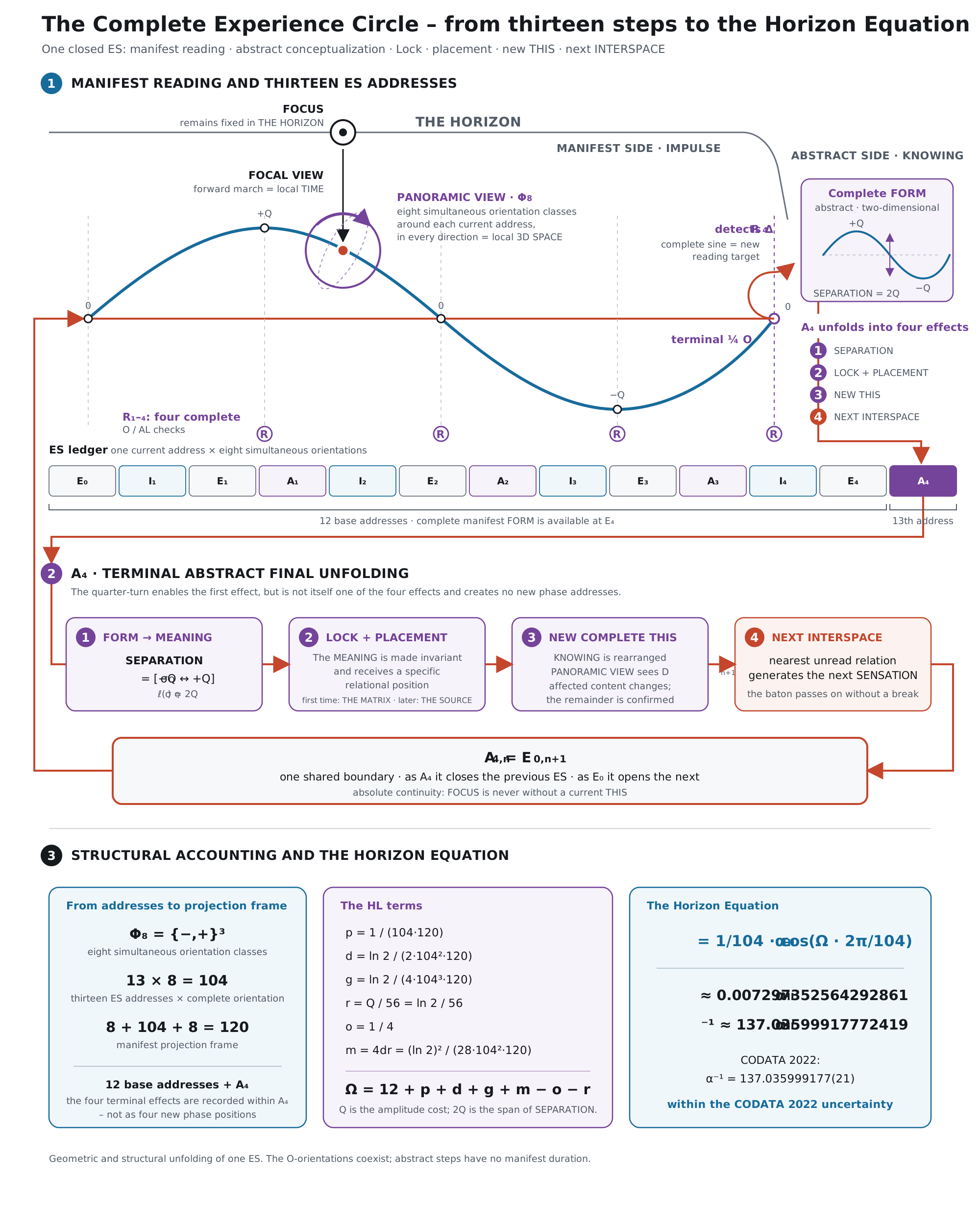 Open the illustration in a separate tab »
We shall now unfold this one continuous event mathematically.
This does not mean that FOCUS counts terms, moves between addresses or performs calculations. The numbers we now introduce belong to our external overview. They make the Mechanism’s structure measurable and make it possible to examine what one full EC reads out as on the manifest side.
We must therefore keep three levels of explanation apart:
- The ontological event: What is actually present through one full EC.
- THE FOCUS VIEW: What FOCUS sees as the current THIS at every functional status.
- The external mathematical presentation: How the event is unfolded as addresses, orientation roles, phase, normalisation and manifest readout.
These are not three different mechanisms. They are the same Mechanism described from three different standpoints.
Thirteen qualitative CHANGESFOCUS does not read the sine as thirteen separate snapshots. The reading is absolutely continuous.
Nevertheless, qualitative CHANGES arise where the reading acquires a new status. It is these CHANGES that the external mathematician can distinguish as addresses.
The complete EC-ledger is:
$V_{13}=\{E_0,I_1,E_1,A_1,I_2,E_2,A_2,I_3,E_3,A_3,I_4,E_4,A_4\}.$
The symbols do not denote three different types of ontological constituents. All thirteen are CHANGES. The letters only indicate the role the CHANGE has in the external description:
- $E$ denotes a manifest structural or boundary change.
- $I$ denotes the CHANGE where the manifest reading begins or continues into a new reading regime without interruption.
- $A$ denotes the point where the simultaneous abstract AE-result becomes focal in the external EC-unfolding.
The AE-result does not arise through a time-consuming calculation between $E_i$ and $A_i$. It is present atemporally in KNOWING. The address $A_i$ marks that the result becomes current in FOCUS’S EC-reading.
This is what the complete ledger looks like:
| No. | Address | Ontological event | FOCUS’S current VIEW | External role |
|---|
| 1 | $E_0$ | THE SENSATION begins to be felt: first from IS-NESS’S recoil against the proto-idea, later from an actualised INTERSPACE | THE PANORAMIC VIEW registers the minimal manifest CHANGE in the complete THIS | Shared boundary and starting address |
| 2 | $I_1$ | The first manifest reading regime opens | THE FOCAL VIEW is bound to the positively rising curve | Entry into the first quadrant |
| 3 | $E_1$ | The curve reaches the first extremum | The first qualitative boundary is present | First check entry |
| 4 | $A_1$ | The AE-result $0$ is present | The form is seen as not yet completed | First abstract check response |
| 5 | $I_2$ | Manifest reading continues | THE FOCAL VIEW follows the positively falling curve | Entry into the second quadrant |
| 6 | $E_2$ | The first zero crossing completes one sine half | The first half-form is present as a complete manifest progression | Second check entry |
| 7 | $A_2$ | The AE-result $0$ is present, and the half-form is registered as a known fragment | The form is seen as half, not as full SEPARATION | Second check response and consolidation boundary |
| 8 | $I_3$ | The oppositely oriented mirror half opens | THE FOCAL VIEW follows the negative curve, whose form is nevertheless known | Entry into the third quadrant |
| 9 | $E_3$ | The curve reaches the opposite extremum | The opposite pole of the known form is present | Third check entry |
| 10 | $A_3$ | The AE-result $0$ is present | The form is seen as still incomplete | Third abstract check response |
| 11 | $I_4$ | The final manifest return opens | THE FOCAL VIEW follows the curve back towards the zero axis | Entry into the fourth quadrant |
| 12 | $E_4$ | The entire sinusoidal form is fully read and zeroed | The complete registered FORM is present | Base address $12$ and final manifest main address |
| 13 | $A_4$ | The AE-result $1$ is present; the terminal O-observation is followed by conceptualisation, Lock, placement, rearrangement and continuation | The form is seen as SEPARATION, then as a building block, as a new complete THIS and as the basis for the next INTERSPACE | Exit address and shared boundary with the next EC |
The ledger thus contains four manifest reading regimes:
- positive rise;
- positive return;
- negative rise in the opposite orientation;
- negative return to zero.
Between the regimes, qualitative boundaries are present where the FORM that has emerged is examined against KNOWING.
Let $a_k\in\{0,1\}$ denote the result status of the AE-examination at address $A_k$. Upper-case $A_k$ denotes the event address; lower-case $a_k$ denotes the result value.
The first three checks give:
$a_1=a_2=a_3=0.$
The terminal check gives:
$a_4=1.$
This is not the calculation:
$0+0+0+1=1.$
The results are not addends. They express that the FORM is incomplete at the first three checks and complete at the last.
The thirteenth address contains more than one VIEWAt $E_4$, the manifest sine reading is finished. The FORM is completed and zeroed.
But FOCUS still sees it as a fully read FORM.
The terminal O-quarter-turn provides the orthogonal perspective on the same two-dimensional FORM. According to the Mechanism’s terminal perspective rule, the already fully read and O-examined FORM thus becomes available as a whole for conceptualisation. AE determines what the FORM is understood as; the positive result is SEPARATION.
The designation $E_5^O$, which we previously used for the entry into the fifth O-examination, does not introduce a fourteenth main address. It denotes the terminal shift in what is current for THE PANORAMIC VIEW. In the ledger, this internal reorientation takes place at the thirteenth main address, $A_4$.
The order is:
$\mathrm{E_4}\longrightarrow\mathrm{terminal\ O\text{-}quarter\text{-}turn}\longrightarrow\mathrm{A_4}.$
The quarter-turn makes four necessary terminal VIEWS possible:
- FOCUS sees the fully read FORM as SEPARATION, and the result is locked for the current event.
- FOCUS sees THE SEPARATION as a definite building block in the whole of KNOWING. This is the placement.
- FOCUS sees the new complete, rearranged THIS.
- FOCUS sees the nearest unread relation as the next INTERSPACE.
The four VIEWS are real CHANGES in the complete EC-process, because each of them gives a qualitatively new THIS.
Nevertheless, they are not four new manifest phase positions. The manifest sine reading has already ended at $E_4$. The four terminal effects are therefore accounted for within the combined effect at $A_4$, not as addresses $14$, $15$, $16$ and $17$.
Why the base address is 12The fully read manifest FORM is present at the ledger’s twelfth address:
$\operatorname{Ordinal}(E_4)=12.$
This is therefore HE’s base address.
The number $12$ does not mean that the thirteenth address is missing. $A_4$ is necessary for conceptualisation and the complete conclusion of the EC. But the manifest FORM that is to be oriented and read out is completed at address $12$.
The effective phase address therefore begins with:
$\Omega=12+\cdots$
The thirteenth address supplies the effects that correct and complete the readout of the FORM at address $12$.
Thirteen is not enough – the FORM must be seen from all sidesAt every qualitative CHANGE, THE PANORAMIC VIEW registers the complete local orientation field.
In section 5.4, we showed that three is the smallest dimension that meets the requirement for a continuous circuit of orthogonal perspective directions around a fixed focal axis. Under the Mechanism’s minimality requirement, the local SPACE is therefore described with three independent orientation axes.
Each direction has two sign orientations:
$\{-,+\}.$
Three independent, two-sided orientation components give:
$\Phi_8=\{-,+\}^3.$
Thus:
$|\Phi_8|=2^3=8.$
The eight elements in $\Phi_8$ are not eight places FOCUS visits in turn. They are the smallest external representation containing all sign combinations of the complete three-dimensional PANORAMIC VIEW.
$\Phi_8$ is an unordered set.
None of the eight orientation classes has an ontological first or last position. Any numbering of them is merely an illustration or calculation convention.
FOCUS therefore does not see eight numbered sectors. It sees the complete current THIS. The eightfold division arises when we unfold this complete view mathematically.
From thirteen addresses and eight orientation roles to 104Each of the thirteen qualitative main addresses is present with a complete PANORAMIC VIEW.
The external product structure is therefore:
$\Omega_{104}:=V_{13}\times\Phi_8.$
The cardinality becomes:
$|\Omega_{104}|=|V_{13}|\cdot|\Phi_8|=13\cdot8=104.$
Thus:
$\boxed{13\cdot8=104}.$
This does not mean that one EC contains 104 sequential ontological events.
There are thirteen qualitative CHANGES. Each CHANGE is present with eight external orientation roles in the complete mathematical unfolding.
$104$ is therefore the complete local EC-ledger when both qualitative address and complete orientation are included.
Equal normalisation weightThe ontology gives no reason why one of the 104 primitive role positions should have a greater manifest counting weight than another.
When the complete ledger is normalised to $1$, one focal position receives the weight:
$\boxed{\frac1{104}}.$
This is the channel weight.
It does not say that all 104 role positions perform the same ontological work. $E_0$, $A_2$ and $A_4$ clearly have different functions. Equal weight only means that each primitive role position occupies one position in the normalised external representation.
HE’s external phase representation uses the same cardinality to divide one full revolution into $104$ equal address units:
$\boxed{\Delta\theta=\frac{2\pi}{104}}.$
This is the phase conversion rule in the representation. The number $104$ follows from the product set; the assignment of equal angular contributions is specified through this rule.
The channel weight and the phase unit thus have the same numerical basis, but different functions:
- $1/104$ determines the weight of the focal channel.
- $2\pi/104$ determines the angle to which one address unit corresponds.
They must not be confused.
The complete projection frame – 120The inner 104-ledger specifies the EC-content to be read out.
But the primitive SENSATION does not carry its abstract address as manifest content. The manifest side shows the impulse, not where the associated relation is situated in KNOWING.
The EC-progression must therefore be framed so that the local reading can appear in its complete manifest context.
The complete all-round registration at the entry is reused as a manifest entry frame:
$8.$
The complete 104-ledger constitutes the inner content:
$104.$
The complete all-round registration at the exit is reused as a manifest exit frame:
$8.$
Thus:
$\boxed{8+104+8=120}.$
The number $120$ does not denote:
- 120 new ontological events;
- a new EC-ledger;
- an additional time axis;
- or 16 new steps that FOCUS must carry out.
The two eight-role frames reuse boundary registrations that are already present. They place the inner 104-structure on the complete manifest “canvas”.
When the entire projection frame is normalised to $1$, one position receives the weight:
$\frac1{120}.$
The inner channel weight and the external frame normalisation act in succession:
$\frac1{104}\cdot\frac1{120}=\frac1{104\cdot120}.$
This is HE’s first positive correction term.
The focal projection termLet:
$p:=\frac1{104\cdot120}.$
$p$ expresses that one focal position in the inner 104-ledger is to appear within the complete manifest 120-frame.
Thus:
$\boxed{p=\frac1{104\cdot120}}.$
The term was historically called the “gate term”. That name is misleading. No gate opens between the domain sides, and nothing is transported through THE HORIZON.
The functional designation is:
The focal projection term.
$p$ enters positively because it places the current channel in the complete manifest readout.
$Q$, $2Q$ and $\ln2$Before we proceed, three different quantities must be kept apart.
The primitive manifest amplitude is:
$Q=\max_\theta|\mathcal F(\theta)|.$
The complete bipolar FORM extends from $-Q$ to $+Q$:
$\mathrm{SEPARATION}\ \widehat{=}\ [-Q\leftrightarrow+Q].$
The geometric span is therefore:
$\ell(\mathrm{SEPARATION})=(+Q)-(-Q)=2Q.$
But THE SEPARATION is simultaneously one binary distinction: One is not the other.
In natural units of information, one binary distinction has the measure:
$\chi_{\mathrm{sep}}=\ln2,$
because:
$e^{\ln2}=2.$
The geometric span $2Q$ and the information measure $\ln2$ are not the same type of quantity. One describes the extent of the bipolar FORM. The other describes the novelty content of one binary distinction.
HE uses $\ln2$ as the primitive amplitude and distinction measure:
$\boxed{Q=\ln2}.$
This is an explicit representation law. It does not follow from $104$, $120$ or sine geometry alone.
Thus, the following hold simultaneously:
$Q=\ln2,$
$\ell(\mathrm{SEPARATION})=2Q=2\ln2,$
and:
$\chi_{\mathrm{sep}}=\ln2.$
That $Q$ and $\chi_{\mathrm{sep}}$ have the same dimensionless numerical measure does not mean that manifest amplitude and abstract MEANING are the same ontological quantity. They are two domain-side measures associated with the same primitive incidence.
No quantity is transported between the domains.
The negative sine part does not give a new $Q$-costThe negative half-form is necessary.
Without it, the impulse would not have:
- opposite polar orientation;
- full closure;
- return to zero;
- or a complete FORM that can be seen as SEPARATION.
But the negative half-form is a mirrored replica of the positive:
$\mathcal F(\theta+\pi)=-\mathcal F(\theta).$
When the first half-form has been read and registered at $A_2$, the geometry of the second half-form is already known. It must still be experienced and confirmed, but it does not give rise to a new full amplitude cost $Q$.
$-Q$ is an orientation sign, not a negative cost.
The complete impulse has amplitude $Q$, not amplitude $Q+Q=2Q$.
The negative half therefore enters HE through:
- the final six main addresses;
- the consolidation region;
- the opposite orientation;
- the closure at $E_4$;
- and the reduced confirmation term.
It must not be entered as another independent $\ln2$-package.
The distinction termIn later EC-readings, the triggering relation is present before completion as INTERSPACE: The relation exists, but its MEANING is missing. In the first event, the starting point is instead IS-NESS’S recoil against the unresolved proto-idea. In both cases, the MEANING of the reading result is established through the completed reading and the positive AE-result.
When AE gives $1$ and FOCUS sees the FORM as SEPARATION after the terminal O-observation, the abstract unresolvedness has ended.
This effect is accounted for as the distinction term $d$.
The current distinction must be seen in relation to the entire context landscape. This gives one 104-role for the current actuality and one 104-role for the context:
$104_{\mathrm{current}}\cdot104_{\mathrm{context}}=104^2.$
These are not two sequential readings of the ledger. It is one relational figure between the current actuality and the complete context.
The primitive event simultaneously has two essentially different domain faces:
$\mathbb D_2=\{M,A\},$
where:
- $M$ denotes manifest SENSATION;
- $A$ denotes abstract SEPARATION.
The event is not halved between the domains. But when the two domain roles are entered as a normalised external coordinate without a metric, each role position receives the weight:
$\frac12.$
HE is a manifest readout. The distinction contribution is therefore entered through the manifest role position:
$\boxed{d=\frac{\ln2}{2\cdot104^2\cdot120}}.$
The two in $d$ has nothing to do with the known negative sine half. It belongs to the normalised coordinate between the two domain sides.
$d$ enters positively because the established SEPARATION contributes constructively to the completed manifest readout.
The confirmation termThe first sine half must be read as new FORM.
After $A_2$, the half-form is present as a known fragment in KNOWING. The negative half-form is the same in form, but with opposite polar orientation.
It must still be read and confirmed. But it does not carry a new full fear or amplitude cost.
This is represented by halving the distinction term and distributing it as one confirming readout over the complete 104-ledger:
$g=d\frac1{2\cdot104}.$
Thus:
$\boxed{g=\frac{\ln2}{4\cdot104^3\cdot120}}.$
The two in $g$ and the two in $d$ thus have entirely different origins:
- The two in $d$ specifies the manifest role position in a normalised two-part domain coordinate.
- The two in $g$ expresses that the mirrored half-form is known and therefore does not carry full novelty weight.
They must not be explained as one general duality principle.
$g$ enters positively because the confirmation contributes to the completion of the FORM.
Differentiation and consolidationThe thirteen-term ledger divides at $A_2$.
Up to and including $E_2$, the first half-form is differentiated manifestly:
$D_6=\{E_0,I_1,E_1,A_1,I_2,E_2\}.$
This part contains six main addresses.
With complete eightfold registration, it receives the external orientation support:
$6\cdot8=48.$
Thus:
$\boxed{48=6\cdot8}.$
At $A_2$, the half-form is present as a known fragment in KNOWING. From this point, the known form is confirmed in the opposite orientation, completed, conceptualised and placed.
The consolidation part is:
$C_7=\{A_2,I_3,E_3,A_3,I_4,E_4,A_4\}.$
This part contains seven main addresses.
With complete eightfold registration, it receives:
$7\cdot8=56.$
Thus:
$\boxed{56=7\cdot8}.$
$48$ and $56$ are not two new universal spaces. They are external orientation supports for two functionally different parts of the same EC-ledger.
The manifest termination termWhen the sine returns to zero, the FORM is closed.
The current qualia impulse must simultaneously cease as this EC’s SENSATION. If the old amplitude remained manifest and the next impulse were added, qualia would accumulate from EC to EC.
The next SENSATION is a new replica with the same universal amplitude. It is not the old impulse with another amplitude added on top.
What is terminated is therefore:
- not THE SEPARATION;
- not THE MEANING;
- not the content of KNOWING;
- and not the bipolar relation.
What is terminated is the old impulse’s manifest actuality.
The termination concerns the amplitude $Q$, not the geometric peak-to-trough span $2Q$ as a double cost.
It is distributed over the consolidation support of $56$ role positions:
$r=\frac{Q}{56}.$
With:
$Q=\ln2$
we obtain:
$\boxed{r=\frac{\ln2}{56}}.$
$r$ is defined as a non-negative quantity. In the effective phase address, it appears as:
$-r=-\frac{\ln2}{56},$
because the old manifest actuality is terminated relative to the positive manifest reading direction.
The minus sign does not mean negative qualia or a separate counter-SENSATION.
The local O-quarter-turnAt $E_4$, the FORM is fully read. The Mechanism’s terminal perspective rule, specified in sections 5.4 and 5.5, states that the already fully read and O-examined FORM becomes available as a whole for conceptualisation from the terminal orthogonal perspective. AE then determines what the FORM is understood as.
In the geometrically unfolded presentation, the terminal reorientation is denoted by:
$\psi=\frac{\pi}{2}.$
The quarter-turn takes place locally within the same terminal 104-cell. It is not two of eight orientation classes and not a displacement to the next phase address.
One local full revolution corresponds to one whole local cell. A turn of $90^\circ$ is one quarter of this:
$o=\frac14.$
Thus:
$\boxed{o=\frac14}.$
The O-turn does not continue along the positive manifest reading direction. In the chosen phase convention, it is therefore entered as an oppositely oriented phase correction:
$-o=-\frac14.$
The choice of right or left global direction of revolution is conventional. A full global reversal sends $\Omega$ to $-\Omega$, but the cosine readout remains the same:
$\cos(-\theta)=\cos(\theta).$
What is structurally determined is therefore not absolute right or left, but that the O-reorientation is orthogonal to the manifest reading direction.
Four terminal effectsAt the terminal actuality, two completions are present simultaneously:
- Abstractly, the reading result is understood as SEPARATION.
- Manifestly, the old SENSATION is fully read and terminated.
The distinction quantity is $d$.
The manifest termination quantity is $r$.
A terminal effect that requires both to be present must vanish if either is missing:
$S(0,r)=0,$
$S(d,0)=0.$
The chosen minimal bilinear representation is therefore:
$dr.$
This does not mean that the two domain sides physically multiply each other. The product is the external accounting for the fact that the effect requires both completions.
After the O-quarter-turn, four functionally independent VIEWS follow:
- Conceptualisation and Lock.
- Placement.
- The new complete THIS.
- The next INTERSPACE.
Each VIEW requires both the complete distinction $d$ and the complete manifest termination $r.$
The four effects are not four quarters of one $dr$. Each effect answers an independently necessary question:
- What is the FORM?
- Where does the MEANING belong?
- What does the whole look like now?
- What must be read next?
Therefore:
$dr+dr+dr+dr=4dr.$
Let:
$m:=4dr.$
Then:
$m=4\left(\frac{\ln2}{2\cdot104^2\cdot120}\right)\left(\frac{\ln2}{56}\right).$
Thus:
$\boxed{m=\frac{(\ln2)^2}{28\cdot104^2\cdot120}}.$
$m$ enters positively because the four VIEWS are constructive effects that complete the EC and carry it forward to the next.
The sign accountingWe now have six correction quantities:
$p=\frac1{104\cdot120},$
$d=\frac{\ln2}{2\cdot104^2\cdot120},$
$g=\frac{\ln2}{4\cdot104^3\cdot120},$
$m=\frac{(\ln2)^2}{28\cdot104^2\cdot120},$
$o=\frac14,$
$r=\frac{\ln2}{56}.$
All six quantities are defined as non-negative:
$p,d,g,m,o,r\geq0.$
The signs are assigned when the quantities are entered into the effective phase address.
The manifest EC-reading from $E_0$ to the fully read FORM at $E_4$ is defined as positive phase orientation.
Contributions that place, establish, confirm and complete the readout are entered positively:
$+p,+d,+g,+m.$
The orthogonal reorientation and the termination of the old manifest actuality are entered negatively:
$-o,-r.$
The sign accounting is therefore:
| Term | Sign | Function |
|---|
| $12$ | $+$ | The base address of the fully read FORM |
| $p$ | $+$ | Focal placement in the complete manifest frame |
| $d$ | $+$ | Establishment of SEPARATION |
| $g$ | $+$ | Confirmation of the known mirror half |
| $m$ | $+$ | The four terminal completion effects |
| $o$ | $-$ | Local orthogonal reorientation |
| $r$ | $-$ | Termination of the old manifest qualia actuality |
The signs express functional direction in the external phase accounting. They do not express good and evil, positive and negative experience or the addition and loss of physical energy.
The effective phase addressAll the terms now have the same mathematical type. They are contributions to one dimensionless phase address.
The effective address is:
$\boxed{\Omega=12+p+d+g+m-o-r}.$
Substituting the individual terms, we obtain:
$\boxed{\Omega=12+\frac1{104\cdot120}+\frac{\ln2}{2\cdot104^2\cdot120}+\frac{\ln2}{4\cdot104^3\cdot120}+\frac{(\ln2)^2}{28\cdot104^2\cdot120}-\frac14-\frac{\ln2}{56}}.$
Numerically:
$\Omega\approx11.737702781507321.$
The dimensionless address is converted into an angle through the phase unit:
$\theta_{\mathrm{HE}}=\Omega\frac{2\pi}{104}.$
Why cosineThe primitive FORM of THE SENSATION is sine.
When the complete EC-event is framed and oriented in the manifest representation, we must read out how much of the oriented amplitude appears along the chosen manifest reference direction.
This projection is expressed by cosine:
$\cos\theta_{\mathrm{HE}}.$
Cosine is not:
- the abstract domain of KNOWING;
- a process that transforms MEANING into qualia;
- the O-quarter-turn;
- or a mathematical actor that creates SPACE.
Cosine is the final manifest readout of the figure that has already been constructed and oriented.
The complete context information has been unfolded as an angle. Cosine reads out the projected manifest value along the reference direction.
The external channel weightThe cosine value lies between $-1$ and $1$.
But HE does not read out the entire unweighted 104-ledger as one local channel. The current readout belongs to one focal position in the normalised whole.
The cosine value is therefore multiplied by the channel weight:
$\frac1{104}.$
We thus obtain:
$\boxed{\alpha_{\mathrm{HE}}=\frac1{104}\cos\left(\Omega\frac{2\pi}{104}\right)}.$
Substituting the fully expanded phase address, the Horizon Equation emerges:
$\alpha_{\mathrm{HE}}=\frac1{104}\cos\left[\left(12+\frac1{104\cdot120}+\frac{\ln2}{2\cdot104^2\cdot120}+\frac{\ln2}{4\cdot104^3\cdot120}+\frac{(\ln2)^2}{28\cdot104^2\cdot120}-\frac14-\frac{\ln2}{56}\right)\frac{2\pi}{104}\right]$
This is the canonical HE-form.
None of the terms can be removed, combined or given new coefficients without making the equation a different one.
The entire equation expressed in one sentenceHE can now be read as one continuous mechanical sentence:
The fully read sinusoidal form stands at address $12$ in a normalised 104-part EC-ledger. The current channel is placed in a complete manifest 120-frame. The primitive $\ln2$-distinction is established in the relation between the current actuality and the entire context. The already known mirror half is confirmed with reduced novelty weight. The completed distinction and the manifest termination give four independent terminal effects. A local orthogonal quarter-turn makes conceptualisation possible. The old qualia impulse is terminated over the $56$ consolidating phase positions. The combined address is converted into an angle, projected by cosine and read out with the weight of one of $104$ focal channels.
This is the Experience Circle expressed as manifest mathematics.
The numerical readoutWhen all the terms are substituted, the Horizon Equation gives:
$\alpha_{\mathrm{HE}}\approx0.007297352564292861.$
The inverse value is:
$\boxed{\alpha_{\mathrm{HE}}^{-1}\approx137.03599917772419}.$
CODATA 2022 recommends:
$\alpha_{\mathrm{CODATA}}=0.0072973525643(11),$
and:
$\alpha_{\mathrm{CODATA}}^{-1}=137.035999177(21).$
The difference between HE and CODATA’s central value, compared through the inverse value, is:
$\Delta\alpha^{-1}=\alpha_{\mathrm{HE}}^{-1}-\alpha_{\mathrm{CODATA}}^{-1}\approx7.24\times10^{-10}.$
CODATA’s stated standard uncertainty for the inverse value is:
$2.1\times10^{-8}.$
The Horizon Equation’s value thus lies approximately:
$0.0345\sigma$
above CODATA’s central value and well within the measurement uncertainty.
The relative difference in the inverse value is approximately:
$5.28\times10^{-12}.$
HE thus does not give exactly the same final decimal places as CODATA’s central value. But CODATA’s central value is not the natural constant’s exact, final number either. It is a recommended value obtained through a combined adjustment of theoretical and experimental data and is accompanied by a measurement uncertainty.
HE’s result is numerically indistinguishable from the fine-structure constant within CODATA 2022’s stated uncertainty.
What the achievement of the objective meansWe did not begin with the fine-structure constant and try to construct a story that could produce the number.
We began with the question of how IS-NESS can experience and know that something is present.
This led us to:
- AWARENESS and FOCUS;
- the manifest and abstract sides;
- THE SENSATION;
- the continuous sine reading;
- local TIME;
- local three-dimensional SPACE;
- THE PANORAMIC VIEW and THE FOCAL VIEW;
- the O-principle;
- the terminal quarter-turn;
- SEPARATION;
- Lock;
- placement;
- rearrangement;
- the new complete THIS;
- THE INTERSPACE;
- and the relay to the next EC.
When this one event was unfolded mathematically, the following emerged:
$13\cdot8=104,$
$8+104+8=120,$
$7\cdot8=56,$
and the combined phase readout:
$\alpha_{\mathrm{HE}}^{-1}\approx137.03599917772419.$
This is the achievement of the objective for the first part of the book.
For me, the numerical agreement indicates that we have found a real connection between the Experience Circle and the mathematical structure of the physical universe.
But we shall not claim more than we have actually shown.
We have shown that the Ontology’s complete EC-structure, together with the explicit manifest representation laws, gives a dimensionless value that lies within the measurement uncertainty of physics’ fine-structure constant.
We have not yet shown why this particular manifest readout must physically appear as electromagnetism’s coupling constant.
This physical identification must be derived later. It cannot be used backwards as a premise for the terms in HE.
Likewise, HE does not contain the full attractor dynamics, AE. The equation expresses the EC-structure and the manifest readout defined through the explicit representation laws in this section.
But the match is there.
The Experience Circle gives a value that physics knows as $\alpha$.
FORMAL PRESENTATION (for specialists) »DEF — the thirteen-term ledgerLet:
$V_{13}:=\{E_0,I_1,E_1,A_1,I_2,E_2,A_2,I_3,E_3,A_3,I_4,E_4,A_4\}.$
Then:
$|V_{13}|=13.$
All the elements in $V_{13}$ are qualitative CHANGES:
$\forall v\in V_{13}:\qquad\operatorname{CHANGE}(v)=1.$
The role labelling is:
$E=\operatorname{ManifestBoundaryChange},$
$I=\operatorname{EntryOrContinuousContinuationOfManifestReading},$
$A=\operatorname{FocalisationOfAbstractAEResult}.$
Let $a_k\in\{0,1\}$ denote the status of the AE-result at address $A_k$. The addresses $A_k$ are different event addresses, even when the result values $a_k$ are equal.
For the checkpoints:
$a_1=a_2=a_3=0,$
$a_4=1.$
REL — base address and terminal addressThe complete manifest FORM is present at the twelfth address:
$\operatorname{Ordinal}(E_4)=12.$
Thus:
$\operatorname{BaseAddress}=12.$
$A_4$ is the ledger’s thirteenth address:
$\operatorname{Ordinal}(A_4)=13.$
$A_4$ contains the terminal effects, but is not four new manifest phase positions.
The terminal O-examination denoted by $E_5^O$ is internal to the transition:
$E_4\longrightarrow E_5^O\longrightarrow A_4.$
But:
$E_5^O\notin V_{13}$
as a new main address.
DEF — the orientation setLet:
$\Phi_8:=\{-,+\}^3.$
Then:
$|\Phi_8|=2^3=8.$
$\Phi_8$ is an unordered set:
$\neg\operatorname{CanonicalOrder}(\Phi_8).$
It represents the sign classification of the complete three-dimensional orientation field. Each class encompasses continuously many directions. The eight classes are not eight sequential FOCUS-operations.
DEF — the 104-ledgerThe complete external EC-ledger is the product set:
$\Omega_{104}:=V_{13}\times\Phi_8.$
Thus:
$|\Omega_{104}|=|V_{13}|\cdot|\Phi_8|=13\cdot8=104.$
Consequently:
$\boxed{N:=104}.$
The channel weight is:
$w_N:=\frac1N=\frac1{104}.$
The phase unit is:
$\Delta\theta_N:=\frac{2\pi}{N}=\frac{2\pi}{104}.$
DEF — the 120-frameThe complete manifest projection frame consists of:
- an entry frame with $8$ orientation roles;
- the inner ledger with $104$ role positions;
- an exit frame with $8$ orientation roles.
Thus:
$R:=8+104+8=120.$
Consequently:
$\boxed{R=120}.$
$R$ does not add new ontological CHANGES:
$120\neq\operatorname{NumberOfEC\text{-}events}.$
DEF — differentiation and consolidation supportThe differentiating address part is:
$D_6:=\{E_0,I_1,E_1,A_1,I_2,E_2\}.$
Thus:
$|D_6|=6,$
and:
$6\cdot8=48.$
The consolidating address part is:
$C_7:=\{A_2,I_3,E_3,A_3,I_4,E_4,A_4\}.$
Thus:
$|C_7|=7,$
and:
$7\cdot8=56.$
DEF — amplitude, span and information measureThe primitive manifest amplitude is:
$Q:=\max_\theta|\mathcal F(\theta)|.$
The bipolar SEPARATION is represented:
$\mathrm{SEPARATION}\ \widehat{=}\ [-Q\leftrightarrow+Q].$
Its geometric span is:
$\ell(\mathrm{SEPARATION})=2Q.$
The information measure for one binary distinction is:
$\chi_{\mathrm{sep}}:=\ln2.$
HE’s primitive representation law is:
$\boxed{Q=\chi_{\mathrm{sep}}=\ln2}.$
This means numerical identity of measure in the external representation, not ontological identity or transport between the domains.
Consequently:
$\ell(\mathrm{SEPARATION})=2\ln2,$
but:
$\chi_{\mathrm{sep}}=\ln2.$
DEF — the focal projection termThe nested channel and frame normalisation gives:
$p:=\frac1{N\cdot R}.$
Thus:
$\boxed{p=\frac1{104\cdot120}}.$
DEF — the distinction termThe normalised domain coordinate is:
$\mathbb D_2:=\{M,A\}.$
Normalisation without a metric and independent of labels gives:
$\mu_{\mathbb D}(M)=\mu_{\mathbb D}(A)=\frac12.$
The current–context relation is represented by:
$N_{\mathrm{current}}\cdot N_{\mathrm{context}}=N^2.$
The distinction term becomes:
$d:=\frac{\chi_{\mathrm{sep}}}{2N^2R}.$
Thus:
$\boxed{d=\frac{\ln2}{2\cdot104^2\cdot120}}.$
DEF — the confirmation termThe negative half-form is a polarity-reversed replica:
$\mathcal F(\theta+\pi)=-\mathcal F(\theta).$
The already known half-form is not assigned a new full $Q$-cost.
The confirmation term is defined:
$g:=\frac{d}{2N}.$
Thus:
$\boxed{g=\frac{\ln2}{4\cdot104^3\cdot120}}.$
The two in $g$ is not the two in $d$.
DEF — the termination termThe old manifest amplitude actuality is terminated over the consolidating support:
$r:=\frac{Q}{56}.$
With $Q=\ln2$:
$\boxed{r=\frac{\ln2}{56}}.$
$r$ is a non-negative quantity, but enters as $-r$ in the phase address.
DEF — the O-termThe terminal orthogonal reorientation is:
$\psi=\frac\pi2.$
As a local fraction of one full revolution:
$o:=\frac{\psi}{2\pi}=\frac14.$
HE’s local representation rule assigns one address unit to one full local revolution. Therefore, $o$ enters as one quarter of an address unit in $\Omega$. The local perspective angle $\psi$ and the combined readout angle $\theta_{\mathrm{HE}}$ are different quantities.
Thus:
$\boxed{o=\frac14}.$
$o$ is a non-negative quantity, but enters as $-o$ in the phase address.
DEF — the four-term completion contributionThe four terminal effects require both $d$ and $r$.
The chosen minimal bilinear representation is:
$dr.$
Four independent terminal effects give:
$m:=4dr.$
Thus:
$m=4\left(\frac{\ln2}{2\cdot104^2\cdot120}\right)\left(\frac{\ln2}{56}\right),$
and:
$\boxed{m=\frac{(\ln2)^2}{28\cdot104^2\cdot120}}.$
DEF — the effective phase addressThe quantities:
$p,d,g,m,o,r\geq0$
are entered with functional signs:
$\boxed{\Omega:=12+p+d+g+m-o-r}.$
Fully expanded:
$\boxed{\Omega=12+\frac1{104\cdot120}+\frac{\ln2}{2\cdot104^2\cdot120}+\frac{\ln2}{4\cdot104^3\cdot120}+\frac{(\ln2)^2}{28\cdot104^2\cdot120}-\frac14-\frac{\ln2}{56}}.$
Numerically:
$\Omega\approx11.737702781507321.$
DEF — the Horizon EquationThe effective angle is:
$\theta_{\mathrm{HE}}:=\Omega\frac{2\pi}{104}.$
The manifest orientation readout is:
$\cos(\theta_{\mathrm{HE}}).$
The focal channel weight is:
$\frac1{104}.$
Thus:
$\boxed{\alpha_{\mathrm{HE}}=\frac1{104}\cos\left(\Omega\frac{2\pi}{104}\right)}.$
Fully expanded:
$\alpha_{\mathrm{HE}}=\frac1{104}\cos\left[\left(12+\frac1{104\cdot120}+\frac{\ln2}{2\cdot104^2\cdot120}+\frac{\ln2}{4\cdot104^3\cdot120}+\frac{(\ln2)^2}{28\cdot104^2\cdot120}-\frac14-\frac{\ln2}{56}\right)\frac{2\pi}{104}\right]$
REL — numerical readoutThe formula gives:
$\alpha_{\mathrm{HE}}\approx0.007297352564292861,$
and:
$\boxed{\alpha_{\mathrm{HE}}^{-1}\approx137.03599917772419}.$
Compared with CODATA 2022:
$\alpha_{\mathrm{CODATA}}^{-1}=137.035999177(21),$
the difference is:
$\Delta\alpha^{-1}\approx7.24\times10^{-10}.$
This corresponds to approximately:
$0.0345\sigma$
of CODATA’s stated standard uncertainty.
PLACEMENTSection 5.7 builds on the completed EC-description from sections 5.1–5.6. After the first event, the recurring relay has the following structure:
$\mathrm{INTERSPACE}_n\longrightarrow\mathrm{SENSATION}_n\longrightarrow\mathrm{FORM}_n\longrightarrow\mathrm{MEANING}_n\longrightarrow\mathrm{LOCK}_n\longrightarrow\mathrm{PLACEMENT}_n\longrightarrow D_{n+1}\longrightarrow\mathrm{INTERSPACE}_{n+1}.$
The section establishes the external mathematical unfolding:
$\mathrm{EC}\longrightarrow V_{13}\longrightarrow V_{13}\times\Phi_8\longrightarrow104\longrightarrow120\longrightarrow\Omega\longrightarrow\alpha_{\mathrm{HE}}.$
The section establishes:
- the thirteen qualitative EC-addresses;
- base address $12$;
- the terminal address $A_4$;
- $\Phi_8$;
- $13\cdot8=104$;
- the channel weight $1/104$;
- the phase unit $2\pi/104$;
- the projection frame $8+104+8=120$;
- the differentiation support $48$;
- the consolidation support $56$;
- $p$, $d$, $g$, $m$, $o$ and $r$;
- the effective phase address $\Omega$;
- the cosine readout;
- the canonical HE-formula;
- and the numerical agreement with the fine-structure constant within CODATA 2022’s measurement uncertainty.
The section precedes:
- the full attractor dynamics, AE;
- the emergence bands as KNOWING’S representation of time ticks;
- movement;
- the further treatment of CONCEPT, IDENTITY and PERSPECTIVE, already introduced in section 5.5;
- the physical identification of $\alpha_{\mathrm{HE}}$ as electromagnetism’s coupling constant;
- physical CHARGE;
- matter and antimatter;
- the further EM-bridge;
- and higher, more complex phenomena.
X- One full EC has thirteen qualitative main addresses.
- The addresses are CHANGES, not thirteen interrupted snapshots.
- $E$, $I$ and $A$ denote roles, not different ontological primitives.
- The manifest FORM is finished at base address $12$.
- $A_4$ is the thirteenth address.
- The terminal O-observation does not introduce a fourteenth main address.
- The four terminal VIEWS are real effects, but not new manifest phase positions.
- A complete three-dimensional PANORAMIC VIEW is represented by eight sign orientations.
- $\Phi_8$ is unordered.
- $13\cdot8=104$.
- $104$ is not the number of sequential ontological operations.
- $1/104$ and $2\pi/104$ have different functions.
- $8+104+8=120$ is a manifest projection frame.
- The two eight-role frames reuse boundary registrations and add no new CHANGES.
- The primitive amplitude is $Q=\ln2$.
- SEPARATION’S bipolar span is $2Q$.
- The information measure for one binary distinction is $\ln2$.
- The negative sine part is included structurally, but does not give a new full $Q$-cost.
- The two in $d$ and the two in $g$ have different origins.
- $48=6\cdot8$ is the differentiation support.
- $56=7\cdot8$ is the consolidation support.
- $r$ terminates the old manifest amplitude actuality.
- $o=1/4$ represents the local terminal O-reorientation.
- $m=4dr$ represents four independent terminal effects.
- Cosine is manifest orientation readout.
- HE’s value lies within CODATA 2022’s measurement uncertainty for the fine-structure constant.
NOT-X- FOCUS does not count thirteen terms.
- FOCUS does not move through 104 positions.
- $104$ is not an object or a structure within KNOWING.
- $120$ is not the number of ontological events.
- $\Phi_8$ is not a sequential AE-sweep.
- The eight orientation classes have no ontological numbering.
- Base address $12$ does not mean that $A_4$ is missing.
- $E_5^O$ is not a new main address.
- The O-quarter-turn is not one of the four $dr$-VIEWS.
- The four terminal effects are not four new phase addresses.
- $Q$ and $2Q$ are not the same geometric quantity.
- $2Q$ is not a double manifest novelty cost.
- $-Q$ is not a negative cost.
- The negative half-form is not a separate counter-SENSATION.
- The information measure $\ln2$ is not identical to the geometric length $2Q$ as a type of quantity.
- The two in $d$ is not due to the sine’s two halves.
- The two in $g$ is not due to the domain sides.
- $104^2$ is not 104 repeated readings of the 104-ledger.
- $120$ must not be entered into all terms without regard to their function.
- The return-home term does not annihilate THE SEPARATION.
- The quarter term’s minus sign does not mean negative qualia.
- Cosine is not the abstract side of the sine.
- HE does not contain the full AE-dynamics.
- The numerical agreement alone is not the completed physical identification of electromagnetism.
BOUNDARY-XSection 5.7 establishes:
- the complete external mathematical representation of one EC;
- the thirteen-term structure;
- $\Phi_8$;
- $104$;
- $120$;
- $48$;
- $56$;
- all of HE’s terms;
- the effective phase address;
- the manifest cosine readout;
- and the numerical achievement of the objective.
The section does not yet establish:
- a full mathematical derivation of AE;
- why the fine-structure constant must physically be electromagnetism’s coupling measure;
- the origin of charge;
- the full mechanism of movement;
- the emergence bands’ abstract representation of time;
- the further treatment of local IDENTITIES and PERSPECTIVES, already introduced in section 5.5;
- or the further physics.
FAIL_CONDThe section fails if:
- the thirteen addresses are treated as thirteen interrupted FOCUS-moments;
- $E$, $I$ and $A$ are treated as three different ontological substances;
- AE is presented as a time-consuming calculation in KNOWING;
- base address $12$ is used to delete the thirteenth address;
- $E_5^O$ is introduced as a fourteenth main address;
- the four terminal VIEWS are added as four new manifest phase positions;
- $\Phi_8$ is treated as eight sequential scans;
- a hidden internal order is introduced in $\Phi_8$;
- $104$ is treated as 104 ontological process terms;
- $120$ is treated as 120 new events or as a clock;
- the two boundary registrations are counted as new CHANGES;
- the channel weight $1/104$ and the phase unit $2\pi/104$ are treated as the same operation;
- $2Q$ is introduced as a new double manifest amplitude or fear cost;
- the negative half-form is deleted from the HE-structure;
- the negative half-form is assigned a new full $Q$-cost;
- $-Q$ is treated as a negative cost;
- the geometric span $2Q$ and the information measure $\ln2$ are treated as the same type of quantity;
- the two in $d$ and the two in $g$ are given the same justification;
- $104^2$ is treated as sequential double reading;
- $56$ is used without the boundary at $A_2$;
- the return-home term is said to annihilate THE SEPARATION;
- the O-quarter-turn is explained as $2/8$;
- $4dr$ is treated as abstract feedback or self-multiplication in KNOWING;
- cosine is treated as an operation in KNOWING;
- one or more terms are removed from the canonical HE-formula;
- coefficients, denominators, exponents or signs are changed without a new mathematical revision;
- the numerical agreement is used as a premise for constructing the ontology backwards;
- or the physical identification of $\alpha_{\mathrm{HE}}$ is declared complete before it has been derived.
Close FORMAL PRESENTATION »